
Thursday 14 August 2025
On Sunday afternoon, Rabbi Charley Baginsky and Rabbi Josh Levy, co-lead of Progressive Judaism, took part in a rally in support of the hostages. As they were talking and expressing their views, they were booed and then escorted off the stage. This attempt to silence a voice within the Jewish community shocked and angered me, as it did many of my progressive colleagues. Some of my Progressive colleagues have even asked, ‘does it make any sense to stay inside the communal conversation?’ Josh and Charley insisted they want to stay within the communal space so that our voice can be heard.
I tend to agree with them. It is better to sit at the table than to be on the menu. But I also understand why some ask, ‘What’s the point?’ Such is the depth of the moral crisis within our people. It didn’t happen in isolation. Our world at large is deeply divided, with entrenched camps that are deaf to anything other than their own views. At least we “liberals” (and I know for some it’s an insult; for me, a badge of honour), we’re still trying to listen to the voice of the other, as did Shammai and Hillel in the Talmud.
I feel the ground shifting under our feet, and there is no way to foresee where it is going. All this violence and disunity have left me lost and hurt. I have attempted to explore once more this tradition that I love and am trying to teach and serve to the best of my abilities.
Standing in synagogue, reciting prayers that proclaim justice, peace, and the divine spark in every soul, I often feel a profound unease, a dissonance, that breaks my heart. As a rabbi, who chose this rabbinic path out of faith in the God of Israel as one of the many expressions of the Divine, and a deep love for our tradition’s wisdom, I hold these sacred words close. Yet, they clash with the world we face today: the horrors of 7 October, when lives were torn apart; the suffering in Gaza, where innocents bear the weight of devastation; and the refusal of some in our community to acknowledge Palestinian pain alongside Israeli grief. This rift between the ideals we pray for – for shalom, peace, for tzedek, justice, for the sanctity of life, as we were all created tzelem Elohim, in the image of God – and the moral crisis before us unsettles us deeply. How can we sing of peace when violence rages? How do we live out our values when silence feels like complicity, but speaking risks division? These questions haunt me, pressing us to reflect on what it means to be Jewish in such a time.
This tension came into blinding light on Sunday, 10 August, at a London rally calling for the release of hostages. Rabbis Charley Baginsky and Josh Levy, leaders of the new Progressive Judaism Movement, were asked to leave the stage, met with boos and jeers. Their fault? They were advocating for equal and humane treatment for all, which included supporting Palestinian self-determination alongside Israeli security. To some right-wing voices in the crowd, this was seen as treason, a betrayal of Israel. According to their binary perspective, criticising Israel’s actions is equal to allying with its enemies. This incident manifests the divisions we face: a refusal to embrace complexity, where nuance is mistaken for weakness or treason and empathy for the “other” is branded disloyalty. As we reflect on this moment, it calls us to respond with an ethic rooted in our tradition, one that transcends such polarities and holds fast to truth and compassion. In other words, it is time to reclaim ethical monotheism, which is at the heart of the Progressive Jewish idea.
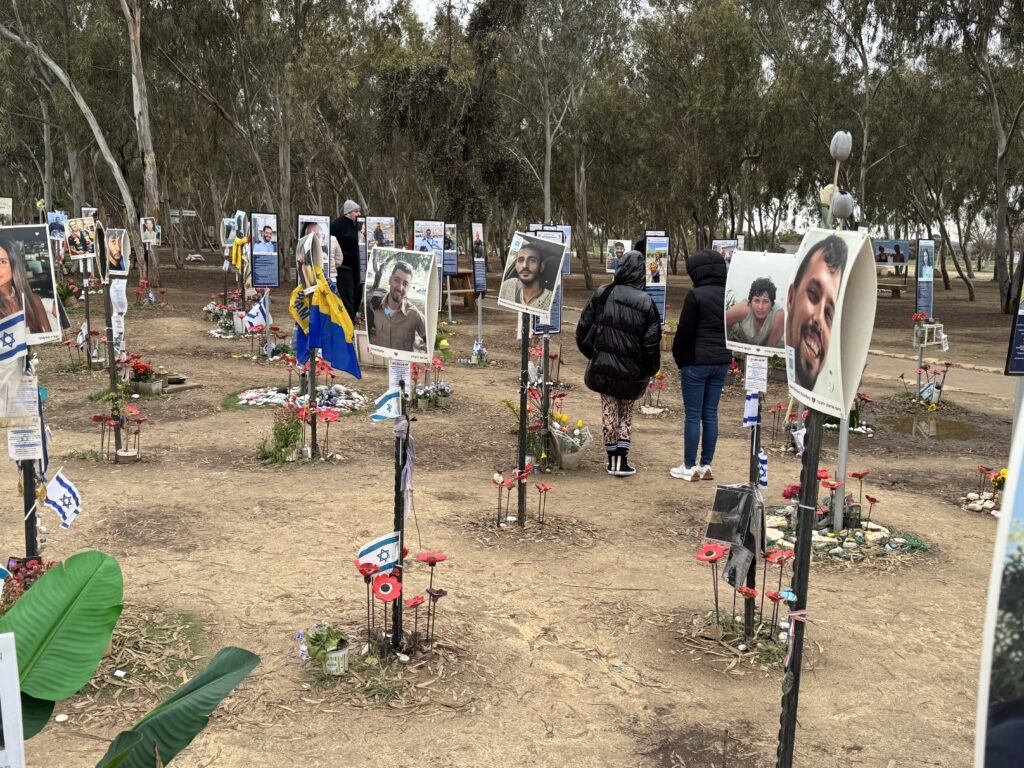
Site of the Nova Festival, southern Israel, February 2025
Our tradition offers a foundation for this challenge: “If a person sins… and is a witness, has seen or known, but does not say, then they shall bear guilt” (Leviticus 5:1). Silence is not neutral: it has a cost. To be a Jew is to bear witness. During my last trip to Israel and the West Bank last February, I saw the photos of these young people slaughtered by Hamas at the Nova festival site, but also the ruins of a Palestinian village destroyed by settlers in the south of Hebron. With my colleagues, we faced abuse by settlers in the old city of Hebron. I was heartbroken by the pain and the destruction I’ve seen. However, I strongly believe, like Josh and Charley, like my many Progressive colleagues, that to speak of both Israeli trauma and Palestinian suffering is not betrayal but covenantal fidelity, a duty to honour the Torah’s call to truth. Yet how do we speak without wounding further? How do we uphold our covenant with God and our community whilst facing truths that some deem divisive?
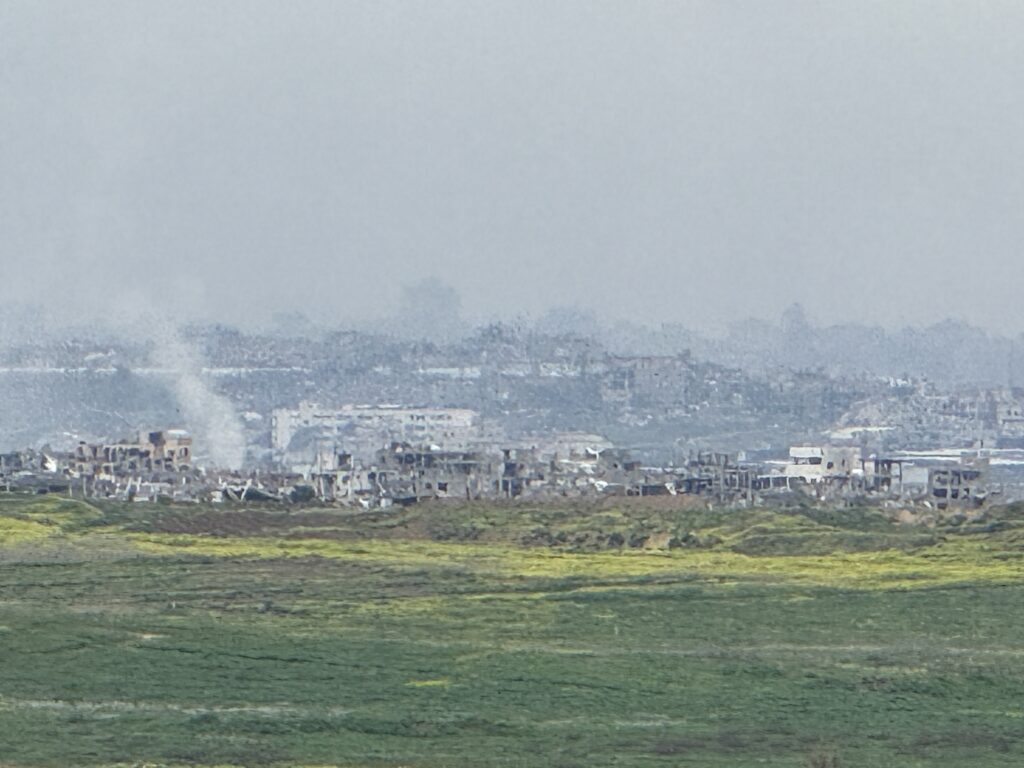
Northern part of the Gaza strip, February 2025
Let us turn to our texts for guidance. Deuteronomy teaches, “This commandment (mitzvah)… is not in heaven… it is in your mouth and in your heart” (Deut. 30:11 – 14). The Talmud reinforces this, with Rabbi Yehoshua declaring, “Lo ba-shamayim hi”, the Torah is not in heaven (Bava Metzia 59b). It is ours to interpret, to bring alive here and now, particularly in this moment of profound crisis. This begins with the idea of the creation of human beings b’tzelem Elohim, in the divine image that resides in every human (Genesis 1:27). Any discourse that fails to acknowledge this, be it for Israelis or Palestinians, collapses under its own gravity. Our texts also teach that derekh eretz, basic human decency, precedes Torah (Vayikra Rabbah 9:3). Observing Mitzvot without any sense of dignity and compassion is pointless. We are called to “love the stranger” (Leviticus 19:34), recalling our history as strangers in Egypt (Exodus 23:9). Yet we also read, “If one comes to kill you, rise early to kill him first” (Sanhedrin 72a). Self-defence is legitimate, but it does not erase our duty towards compassion.
This is our challenge: to love Israel, its people, and its land without letting that love become idolatry. The prophet Amos warns, “I hate, I despise your festivals… (instead of observance without proper values), let justice roll down like waters, and righteousness like an ever-flowing stream” (Amos 5:21–24). Amos critiques Israel’s devotion to ritual when it overshadows ethical duty, reminding us that love for our land and tradition must not blind us to justice. For two millennia, Judaism flourished as the ethic of the powerless, “because you were strangers in Egypt” (Exodus 22:20). The creation of the State of Israel in 1948 was the expression of one simple truth: Jewish power is a necessity, vital for our protection and self-reliance after centuries of vulnerability. Yet this power raises a profound question: How do we wield it ethically? Unchecked, it risks not only harm to others but the very soul of Judaism. To ignore Palestinian suffering or Israeli grief is to betray the Torah’s call to see every human being created tzelem Elohim.
How, then, do we respond? I propose five principles, rooted in our tradition, to guide us through this crisis, particularly in light of events like the London rally, where voices of compassion were silenced:
- B’Tzelem Elohim bara oto (Genesis 1:27): Every person, created in the image of God, bears the divine image, a truth that anchors our ethics. To dehumanise Israelis, denying their grief or right to safety, is to erase this divine spark. To dehumanise Palestinians, ignoring their suffering or displacement, is equally a betrayal. In a crisis where rhetoric often vilifies one side, this principle of creation b’tzelem Elohim demands we recognise the humanity in both, rejecting language that reduces either to unworthy of human dignity. How do we speak of one’s pain without negating the other’s? This principle, ignored when Rabbis Baginsky and Levy were booed off stage, calls us to hold both truths, even when it feels impossible.
- Lo Ta‘amod al Dam Re‘ekha (Leviticus 19:16): “Do not stand idly by the blood of your neighbour”. It compels us to act when lives are at stake. Jewish blood, spilt on 7 October, threatened by ongoing violence, demands our advocacy for safety and justice. Palestinian blood, shed in Gaza’s devastation and lost to settler violence, equally calls us to speak out. This principle challenges us: whose blood do we see? Whose suffering do we prioritise? It demands active engagement, not silence, to protect all lives as sacred, rejecting the binary that plays one side’s pain against the other’s, as seen in the rally’s rejection of another voice.
- Emet u’ Misphat Shalom (Zechariah 8:16): Truth and peace must go hand in hand. Speaking truth means naming the abomination of 7 October and the devastation in Gaza without hesitation. Yet truth alone can wound if not paired with a pursuit of peace. This principle asks: How do we speak harsh truths without fuelling hatred? It calls us to foster dialogue that seeks shalom, not a distant ideal, but a commitment to reducing harm and building understanding, countering the divisive reactions that silenced compassionate voices at the rally.
- Mishpat va-Chesed (Micah 6:8): Justice (mishpat) and compassion (chesed) must balance security and mercy. Israel’s need for self-defence is undeniable, rooted in our history of survival. Yet compassion requires us to consider the cost of that security on innocent lives in Gaza and beyond. This principle challenges us: how do we protect our people without losing our humanity? It calls for actions that uphold justice whilst extending mercy to the stranger, challenging the binary view that equates criticism with disloyalty, as witnessed in the rally’s response.
- Teshuvah (Yoma 86b): Repentance is the path of growth, requiring us to correct our errors openly. In this crisis, we may err by speaking too harshly, overlooking a perspective, or failing to act. Teshuvah asks: where have I fallen short? It demands public accountability to rebuild trust and align our community with our values. After incidents like the London rally, where division overshadowed unity, this principle calls us to reflect and recommit to a Judaism that embraces complexity and compassion.
To live these principles, we must approach controversy with care and precision. Like Hillel, we present opposing views respectfully before our own (Eruvin 13b). We set firm boundaries: no dehumanisation, no denial of trauma, no conspiracies, no inflammatory analogies. In community discussions, we begin with the Torah and texts in tension, like Sanhedrin 72, which permits self-defence, and Exodus 23:9, which calls for universal compassion, and we let them shape our words. We speak with kavanah, intention, not to perform ideology but to safeguard this tzelem Elohim. And we commit to teshuvah, reflecting publicly on what we’ve learnt and how we’ll grow.
This is what defines progressive rabbinic leadership: textual honesty, pastoral courage, and a refusal to reduce complexity to binaries. The abominations of 7 October and the devastation in Gaza, including the routinisation of settler violence, are both truths we must name. To do so is not relativism but moral clarity. Our role is to foster a communal space where grief, accountability, and hope coexist, a Judaism that remembers we were strangers and thus loves the stranger (Exodus 22:20). The London rally shows what happens when we reject nuance: we fracture our community. Instead, let us amplify voices of compassion, rebuild dialogue, and hold fast to our tradition’s ethical core.
As we face this crisis, our tradition calls us to hold hard truths without despair. Rabbi Hillel taught, “If I am not for myself, who will be? If I am for myself alone, what am I? If not now, when?” (Pirkei Avot 2:5). We are called to be witnesses, not arbiters, to be these voices of conscience, speaking truth with compassion. May we find the courage to testify, the wisdom to argue kindly, and the faith to believe in a world made whole. Gam zeh ya’avor, “This too shall pass’, but it is up to us to shape what comes next.
Sources: Genesis 1:27; Exodus 22:20, 23:9; Leviticus 5:1, 19:16, 19:34; Deuteronomy 10:19, 30:11–14; Amos 5:21–24; Zechariah 8:16–19; Micah 6:8; Bava Metzia 59b; Eruvin 13b; Sanhedrin 72a; Yoma 86b; Pirkei Avot 2:5.