
Maidenhead Synagogue
10 January 2026 / 21 Tevet 5786
Most of us know what it feels like to be “on fire”.
Not in the glamorous sense; more in the modern sense: the constant heat of expectations, the pressure to perform, the endless stream of messages and news, the quiet anxiety that you are always behind, always failing someone, always meant to be more efficient, more accomplished, and more resilient.
The Torah does not romanticise that experience. It names it. In Parashat Shemot, Moses encounters a bush that is burning. The text does not deny the flames. It simply adds a detail that changes everything:
“The bush was burning, yet it was not consumed.” (Exodus 3:2)
That single line offers one of the Torah’s most profound images of spiritual life. It is not a promise that life will be free of fire. It is a vision of what it means to live intensely and how to live a fulfilled life by facing its challenges with resilience.
Resilience is often misunderstood as toughness: don’t feel, don’t need, don’t break. In that model, the goal is to become less affected by the world.
The burning bush suggests the opposite. The bush is affected. It burns. It is exposed. It is vulnerable. And yet it is not consumed.
Resilience, then, is not numbness. It is not the absence of struggle. It is the capacity to stay present, to keep your inner life intact, while living through pressure, disappointment, grief, or responsibility.
In a culture that often rewards self-exhaustion and calls it ambition, the burning bush offers a different aspiration: a life that has fire but not devastation, passion but not collapse, and purpose but not self-erasure.
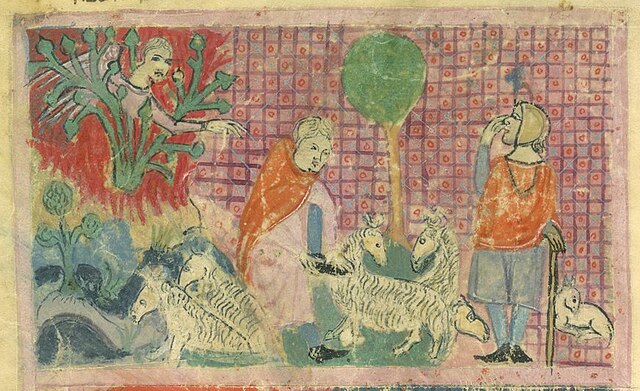
Moses at the burning bush, The Sister Haggadah, British Museum (14th century)
As if the image of the bush were not enough, the Torah places alongside it one of the most staggering moments in religious literature: Moses asks God for a name to bring back to his people. If they ask me, Who is this God that is calling upon us?, what should I answer? He is not asking out of idle curiosity. He is asking because names have significance and impact. Names help us speak. Names help us hold on. Names turn chaos into an address.
And God answers with words that have puzzled countless generations of commentators:
“I will be what I will be.” (Exodus 3:14)
However we translate that phrase, its direction is unmistakable. The divine name leans forward. It does not anchor Moses in what has been. It does not even give him the comfort of a fixed “I am”. It offers a future tense: “I will be.” In Hebrew, there is no future tense in the way we understand it in modern languages. Either something is perfected, accomplished, i.e., is in the past, or it is imperfect, still in the process of becoming, i.e., in the future.
That changes how we read the burning bush. The bush is not only about surviving what burns right now. It is about becoming, about not being reduced to the current moment, the current fear, the current identity, or the current crisis.
A future-tense God is not one who is absent from the present. It is a God who insists that the present is not the whole story. Present is a fleeting moment between a past that cannot be changed and a future that is to be built, created. God cannot be captured by one name, one image, one mood, or one phase of life.
That is a difficult idea to comprehend and also a deeply hopeful one. It means that holiness is not reserved for those who feel finished or certain. There is a way to live religiously inside an unfinished life.
So, what does this future-tense/imperfect theology demand of us now?
Here the Torah becomes beautifully concrete. Before Moses has a plan, before he has confidence, he is simply called by name: “Moses, Moses!” And he answers with one word:
“Here I am.” (Exodus 3:4)
This verse is one of the most important religious sentences in the Bible. It is not a speech. It is not an explanation. It is not a guarantee of success. It is presence.
To say “Here I am” is to resist the temptation to disappear into distraction, cynicism, numbness, or denial. It is to make oneself available: to reality, to conscience, to relationships, to God. It is a willingness to take the next step without pretending you can see the entire road.
And now the logic of the passage becomes clear. The Torah provides us:
- an image: a bush that burns but is not consumed (Exodus 3:2)
- a name: “I will be what I will be.” (Exodus 3:14)
- a response: “Here I am” (Exodus 3:4)
Together they form a single spiritual argument: life contains fire; the future remains open; what is asked of us is presence.
But an image, a name, and a response are not yet a way of life. If we want to live with fire without being consumed, we need practices and structures strong enough to hold intensity.
Judaism has always known this. It does not rely on moods. It builds rhythms. It creates a framework that is operative even when we find it difficult to fully inhabit it. It is there, always, even when we err.
Shabbat is one such rhythm. Shabbat is a weekly refusal to be consumed by endless doing. It is a protest against the idea that you are only as valuable as your productivity. Shabbat teaches that stopping is not weakness. It is spiritual strength. It creates a sanctuary in time where the soul can cool, breathe, and return to itself.
Learning is another. Torah study is not only about acquiring knowledge; it is about forming judgement. A fire without wisdom can scorch. Learning gives fire direction. It refines passion into responsibility.
Community is yet another. The biblical story is never merely private. Moses is called into a people’s reality. We are not meant to carry life alone. One of the most countercultural spiritual acts is to let ourselves be held by friends, by the community, by shared rituals, and by the simple truth that we belong to something bigger than our little persons.
And everyday acts of integrity and kindness matter more than we admit. Future-tense spirituality is not vague optimism. It is made real in the present tense: in how we speak, apologise, refuse to humiliate, notice who is left out, and protect another’s dignity.
Shabbat shalom.