Parashat Lech-Lecha
1 November 2025 / 10 Cheshvan 5786
Maidenhead Synagogue
One of my teachers at Leo Baeck College, Rabbi Shoshana Boyd-Gelfand, once asked us a question that has stayed with me throughout my rabbinate: “What is your parashah? What is the passage that defines you and your future rabbinate?” Without hesitation, I thought of Parashat Lech Lecha, particularly its opening words: לֶךְ-לְךָ מֵאַרְצְךָ (Lech lecha me’artzecha) – “Go forth from your land” (Genesis 12:1).
Over the years, I’ve come to understand this passage not simply as an account of Abraham’s life journey, but as a perpetual call to self-discovery that resonates in every generation. It’s why I often ask my congregants, “What is your lech lecha moment?”
The opening verse of our parashah presents us with an immediate grammatical puzzle that has captivated Jewish commentators throughout the ages. When God commands Avram to begin his transformative journey, the Divine voice declares לֶךְ-לְךָ (lech lecha), commonly translated as “go forth.”. Yet this translation doesn’t capture the full Hebrew meaning. The verb לֶךְ (lech) alone means “go”; the addition of לְךָ (lecha), meaning “to/for yourself”, appears grammatically redundant.
Why does the Torah employ this unusual construction at such a pivotal moment in Jewish history? The answer, I believe, contains the key to understanding not just Abraham’s journey, but our own.
Multiple Dimensions of Meaning
Rashi: The Journey for Benefit
Rashi, the famous mediaeval commentator, addresses this grammatical oddity, interpreting לְךָ (lecha) to mean “for your benefit and for your good” (לַהֲנָאָתְךָ וּלְטוֹבָתְךָ). According to his reading, God reassures Avram that, while leaving behind everything familiar might appear to be a sacrifice, it would ultimately serve his own good. In the land of Canaan, Avram would merit children, wealth, and renown, blessings that would elude him if he stayed in Haran. And these blessings would eventually follow all of his descendants.
This interpretation transforms the command from a mere directive into a promise. As Rabbi Jonathan Sacks observed, sometimes we must relinquish our past to acquire our future.
The Zohar: Journey to the Soul
The Zohar, the foundational text of Jewish mysticism, offers a radically different reading. According to the Zohar (I:78a), “Lech lecha” means “Go to yourself”—a”directive for spiritual ascent and self-discovery. The Divine call invites Avram to journey into the depths of his soul, and uncover the divine spark within. As Rabbi Eleazar in the Zohar reads these words, “Lech lecha, go to yourself! Search deep within to discover your true self.”
This interpretation suggests that the physical journey from Mesopotamia to Canaan paralleled an internal journey from material existence towards unity with the Divine, a profound spiritual transformation that every soul must undertake.
Nachmanides: Establishing Eternal Patterns
Nachmanides (Ramban) introduces another layer through the famous principle of “ma’aseh avot siman l’banim”—”The actions of the parents are a sign for the children.” He perceives in Avram’s journey a template that would be replicated throughout Jewish history. The grammatical doubling of “lech lecha” hints at this dual nature: a physical journey that establishes metaphysical patterns for all future generations.
The Malbim: The Soul’s Descent
The nineteenth-century commentator Malbim understands “lech lecha” as “go to yourself”—an instruction for Avram to discover his essence by casting off negative influences from his homeland, birthplace, and paternal home. In his allegorical interpretation, this represents the soul’s descent from heaven into the physical world, where it must transform the body into a vehicle for divine service.
Rabbi Sacks: Four Dimensions
Rabbi Jonathan Sacks synthesised centuries of interpretation into four distinct dimensions of “lech lecha”:
- Journey for yourself – for your benefit (following Rashi)
- Journey with yourself – carrying your beliefs wherever you go
- Journey by yourself – in solitude and distinctiveness
- Journey to yourself – towards self-realisation
Each reading illuminates different facets of the Jewish experience and the human condition.
Consider Abraham’s situation. He was 75 years old, settled, and established. The call to “lech lecha” must have seemed absurd, even cruel, a sort of Divine irony. Yet he heard something in those words that transcended the literal command. He recognised what we might call a “transformative moment” – an intersection on his life’s journey where staying put would mean spiritual stagnation.
But here’s something crucial these commentators are collectively teaching us: Divine calls rarely announce themselves with fanfare. They often arrive disguised as disruptions, opportunities, or even crises.
How many such moments pass us by because we’re not listening? The redundant לְךָ teaches us that these calls operate on multiple frequencies simultaneously: the external call (a job opportunity in another city, a chance to volunteer for a cause, an invitation to study something new), the internal echo (that persistent feeling that you’re meant for something more, that quiet voice suggesting a different path), and the spiritual resonance (the sense that this moment connects to something larger than yourself).
What made Abraham’s response remarkable wasn’t just his obedience. It was his ability to hold multiple truths simultaneously. According to our tradition, Abraham’s faith was tested no fewer than ten times, and he persevered through each trial. As Rabbi Tamar Rabinowitz poignantly notes, between receiving the initial call at age 75 and God’s renewal of the command at age 99, Abraham “wandered aimlessly like a lost sheep,” yet God returned to him with the message, “Hithalech lefanai”—keep walking.
This teaches us perhaps the most important lesson: Lech lecha moments don’t promise just clarity. They also promise meaning. They don’t guarantee success. They guarantee growth.
The grammatically “superfluous” לְךָ reminds us that transformation isn’t a single dramatic moment. It’s an ongoing process of becoming. Every time we choose growth over comfort, risk vulnerability in a relationship, stand up for our values when it would be easier to stay silent, or leave behind an outdated version of ourselves, we are living out our own lech lecha.
Find your own Lech Lecha moments.
This week, I invite you to engage in what we might call “lech lecha listening”. Each morning, before the rush of the day begins, ask yourself:
- What is calling to me that I’m resisting?
- What familiar pattern am I being invited to leave behind?
- Where is my “promised land”—not a geographical location, but a spiritual disposition?
The beauty of “lech lecha” is that it’s both a command and an invitation. It acknowledges that transformation requires leaving something behind – me’artzecha (from your land), u’mimoladetecha (from your birthplace), and u’mibeit avicha (from your father’s house). These aren’t just physical places; they’re the psychological and spiritual structures that once sheltered us but now constrain us to the place that I will show you. There, you shall discover what you have always been meant to be.
The call of lech lecha didn’t end with Abraham. It echoes through every generation, in every soul willing to listen. The question isn’t whether you’ll receive such a call. You already have, multiple times. The question is whether you’ll recognise it and have the courage to respond.
For us, the descendants of Abraham and Sarah, “lech lecha” remains a living command. We are invited to embark on our own journeys – geographical, spiritual, and psychological – always carrying within us the divine spark that seeks expression in the world. The grammatical peculiarity reminds us that true journeys operate on multiple levels simultaneously: we go out to go in, we leave to arrive, and we depart from the familiar to discover who we truly are.
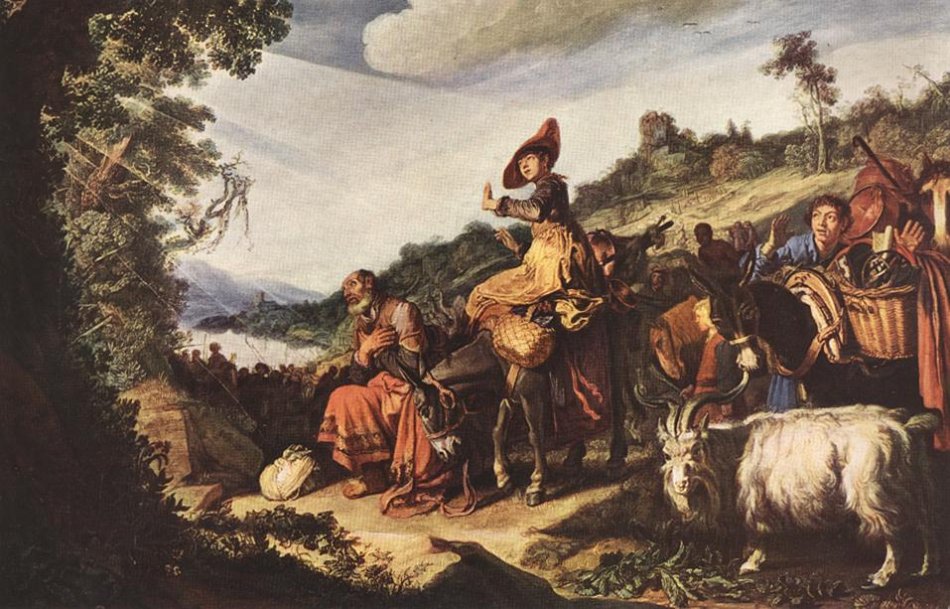
Pieter Lastman, Abraham on the way to Canaan, 1614, Hermitage, St Petersburg.