
In this week’s parashah, Nasso, we read one of Torah’s most troubling passages: the ritual of the Sotah, the woman suspected of adultery. It is a text that makes us uncomfortable, to say the least. It describes a system where suspicion alone triggers public humiliation, where a woman’s body becomes an object of divine testing, where shame is posed as justice.
When a husband suspected his wife of adultery but lacked proof, the woman was brought to the Tabernacle (or later, the Temple), where a priest prepared “bitter waters,” a mixture of sacred water and dust from the sanctuary floor, into which he dissolved a written curse invoking divine judgement with God’s name written on the parchment. The woman would drink the water after making an oath of innocence. If she was guilty, the waters were believed to cause her physical harm; if innocent, she remained unharmed and could conceive.
How strange, right? We must not ignore this discomfort. Challenging texts demand our careful examination, not our avoidance, precisely because of their complexity and the challenges they pose to modern readers. And when we approach this text with honesty, we discover something remarkable: the Torah itself provides the tools for its transformation as a tool for healing.
Emily Carp, a 2nd year student at the Leo Back College, whom I have the privilege to be the tutor of, writes in her thoughtful D’var Torah for this Shabbat: “What if the ritual was never meant to be used? What if it was always meant to disturb us? What if it was always meant to teach us how far is too far?” Her insight points us toward a profound truth about how Torah: as its etymology reveals, Torah is a teacher; it provides us with instruction, guidance. So, let us learn from Torah.
The Mishnah tells us that Rabbi Yochanan ben Zakkai, the sage who rebuilt Jewish life from the ashes of Roman destruction, abolished this ritual entirely (Mishnah Sotah 9:9). Not because it was inconvenient, but because it had ceased to function. Perhaps, as Emily suggests in her analysis, it was never meant to function at all. Perhaps it was always meant to teach us how far is too far. As Rabbi Moshe Zemer z’’l taught us, when a Halacha is not ethical, don’t follow it. If a ritual is meant to humiliate someone, it must not be performed, and if it is written in our sacred texts, it is there to make us reflect on what not to do.
I would like to push deeper into what this text reveals about the very purpose of Torah and community life. Because buried within this troubling ritual is a revolutionary principle that we must remind ourselves of over and over again.
Notice what must be destroyed for the Sotah ritual to proceed: the name of God. The divine name is scraped from parchment, dissolved in water, and erased. It is the only time in all of Torah when we are commanded to obliterate the sacred name, a name so holy we dare not even pronounce it.
This erasure is not incidental. It is central. And it teaches us something profound: any system that requires the destruction of the divine image to function is fundamentally broken.
What is the divine image? It is not ink on parchment. It is the tzelem Elohim , the image of God, the divine reflection that resides in every human being. It is what Martin Buber called the eternal Thou that we encounter in an authentic relationship when my personal space meets your personal space. It is the fundamental dignity that makes each person sacred.
The Sotah ritual fails because it begins by erasing this sacred image, by reducing a person to an object of suspicion, a thing to be tested rather than a soul to be encountered. But, as Emily reminds us in her sermon, the Torah, in its wisdom, gives us Rabbi Meir’s counter-narrative.
When a woman vowed to spit in Rabbi Meir’s eye, he could have insisted on his honour, his authority, his righteousness, and refused. Instead, he chose encounter. The story goes, a husband dared his wife to spit in Rabbi Meir’s face before coming back to her because he was furious she went to listen to the sage’s lecture and wasn’t home for him, Rabbi Meir said, “Let her spit in my eye seven times, for if the divine name may be erased to make peace between husband and wife (he is referring to the Sotah ritual), how much more should I be willing to be humiliated to bring peace to Israel” (Leviticus Rabbah 9:9).
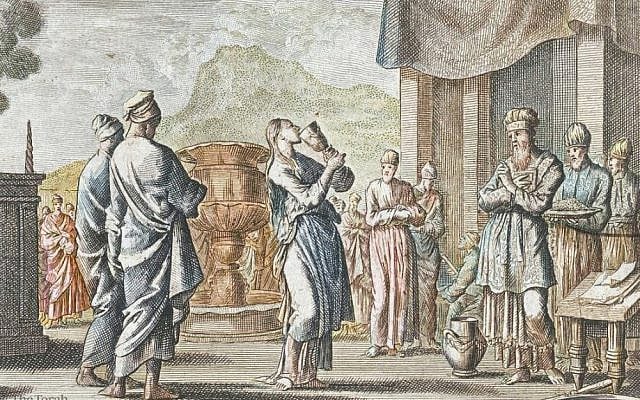
The Sotah Ritual, Jan Luyken, 1703 – 1762 (Rijksmuseum)
Here is the revolution hiding in plain sight: Rabbi Meir transforms the erasure of God’s name from an act of destruction into an act of creation. Not the creation of power or control, but the creation of space, a sacred space where healing becomes possible.
This is what I call the ultimate act of resistance. Resisting does not mean taking up arms and fighting; resisting is the radical choice to meet the other not as an object but as a subject, not as a threat but as a gift, and not as a problem to be solved but as a mystery to be honoured.
Today, we live in a world that has perfected the art of the Sotah ritual. We have platforms where suspicion becomes spectacle, where public humiliation masquerades as justice, where the complexity of human relationships is reduced to the brutal simplicity of guilty or innocent, right or wrong, us or them.
But Parashat Nasso calls us to something different. It calls us to the mature recognition that our differences are not threats to be eliminated but gifts to be received. It calls us to abandon the win/lose dynamics that poison our discourse and embrace the harder path of genuine encounter. Every one of us carries a sparkle of the divine; every one of us is a vessel for holiness.
Diversity is to be celebrated, not feared. The world is complex, and any attempt to simplify it leads to fascism. When we build communities, we leave space for the sacred encounter, for the expression of all diversities, all complexities. The radicality of encounter is not about winning arguments. It is about transforming relationships. It is about building communities where the divine image is preserved, not erased. Where sacred space is created, not destroyed. Where healing becomes possible, not through the bitter waters of humiliation, but through the living waters of genuine meeting.
The name of God, which was erased in the Sotah ritual, is written anew every time we choose encounter over erasure, relationship over judgement, and healing over harm.
May we have the courage to write it well and to become the writers, the authors and the creators of a reconciled humanity.
Shabbat shalom.