At first glance, esotericism and mysticism might seem like interchangeable terms, but they represent distinct yet complementary paths toward deeper spiritual understanding. First, I want to define each term and then see how they fit into Progressive Judaism. Is it possible to be on a mystical or esoteric quest as a progressive Jew?
Esotericism refers to special forms of revelatory knowledge passed down through generations. It encompasses a rich tapestry of traditions spanning from antiquity to the present day, including Gnosticism, Hermeticism, Neoplatonism, Astrology, Alchemy, and the profound wisdom traditions of Jewish and Christian Kabbalah. More recent expressions include movements like Rosicrucianism, the New Age, and various ritual magic traditions.
What binds these diverse paths together is their emphasis on initiation, transformative rituals, and the concept of sacred knowledge accessible only to those who have prepared themselves to receive it. Unlike exoteric teachings available to everyone, esoteric wisdom unfolds gradually as one progresses on the spiritual journey. At first glance, Judaism does not seem to fit into this category. Rabbinic Judaism is based on the assumption that all knowledge must be accessible to everyone. Life-cycle events could be regarded as initiatory moments, but are they?
Mysticism, by contrast, centres on the direct experience of communion with ultimate reality—what many call “God”—achieved through meditation, prayer, rituals, and contemplative practices. It’s about transcending ordinary consciousness to experience the divine directly, often described as a state of ecstatic union. There are signs within the Jewish tradition that some sought such a path of enlightenment.
The Rich Diversity of Jewish Mystical Tradition
Jewish mysticism has evolved through distinct historical phases, each adding depth and nuance to this living tradition:
Biblical Foundations: The seeds of Jewish mysticism appear in the earliest biblical narratives. Jacob’s transformative dream of a ladder reaching to heaven and his nightlong wrestling with a mysterious being represent profound encounters with the divine (Genesis 28). Moses’s experience at the burning bush and the collective revelation at Mount Sinai established direct divine-human communication as central to Jewish spiritual experience (Exodus 3).
Prophetic Consciousness: The Hebrew prophets cultivated a direct relationship with the Divine that enabled them to perceive future events and guide the people through challenging times in accordance with God’s will. Their visionary states represent one of Judaism’s earliest forms of mystical consciousness.
Apocalyptic Visions: Toward the end of the biblical period, texts like the Book of Daniel and the pseudepigraphic Book of Enoch emerged with powerful visions of cosmic transformation. These apocalyptic traditions began in the late Second Temple period (2nd century BCE) and influenced early Christian mysticism.
Early Rabbinic Explorations: The rabbinic period saw the development of several mystical schools, including ma’aseh merkabah (focused on Ezekiel’s divine chariot vision), ma’aseh bereishit (exploring creation’s secrets), and hekhalot literature (describing journeys through celestial palaces). Rabbi Shim’on Bar Yochai, a 2nd-century sage, is traditionally associated with the Zohar, though modern scholarship attributes its authorship to Moses de Leon in the 13th century.
Mediaeval Flowering: The Middle Ages witnessed the emergence of Kabbalah as Judaism’s central mystical tradition, with seminal texts like Sefer ha-Bahir (12th century) and the Zohar (13th century). Jewish communities in Muslim lands developed Sufi-influenced contemplative practices, while German Pietists (Hasidei Ashkenaz) cultivated their distinctive mystical approach.
Since the Middle Ages, Kabbalah has remained the primary expression of Jewish mysticism, offering profound insights into creation’s mysteries and the nature of the divine-human relationship.
The Cautionary Wisdom of the Sages
The rabbis recognised both the transformative potential and the inherent risks of mystical exploration, as illustrated in these Rabbinic texts:
Mishnah Chagigah 2:1
One may not expound the topic of forbidden sexual relations before three or more individuals; nor may one expound the act of Creation and the secrets of the beginning of the world before two or more individuals; nor may one expound by oneself the Design of the Divine Chariot, a mystical teaching with regard to the ways God conducts the world, unless he is wise and understands most matters on his own. The Mishna continues in the same vein: Whoever looks at four matters, it would have been better for him had he never entered the world: anyone who reflects upon what is above the firmament and what is below the earth, what was before Creation, and what will be after the end of the world. Anyone who doesn’t care for their Maker’s honour and meddles in forbidden matters should never have been born.
Chagigah 14b
The Sages taught: Four entered the orchard [pardes], i.e., dealt with the loftiest secrets of Torah, and they are as follows: Ben Azzai and ben Zoma; Aḥer, the other name for Elisha ben Avuya; and Rabbi Akiva. Rabbi Akiva, the senior among them, said to them: When, upon your arrival in the upper worlds, you reach pure marble stones, do not say: Water, water, although they appear to be water, because it is stated: “He who speaks falsehood shall not be established before My eyes” (Psalms 101:7). The Gemara proceeds to relate what happened to each of them: Ben Azzai glimpsed at the Divine Presence and died. And with regard to him, the verse states, “Precious in the eyes of the Eternal is the death of His pious ones” (Psalms 116:15). Ben Zoma experienced harm and lost his sanity when he glimpsed the Divine Presence. Regarding him, the verse asks, “Have you found honey?” Eat as much as is sufficient for you, lest you become full from it and vomit it” (Proverbs 25:16). Aḥer chopped down the shoots of saplings. In other words, he became a heretic. Rabbi Akiva came out safely.
Questions for Reflection and Discussion
- Who are the four figures in this text who enter the Pardes?
- What spiritual practice do you think believe they are following
- the metaphors: What might the Pardes (orchard) represent? What could marble stones and water symbolise in a mystical journey?
- Consider each person’s fate: What do the scriptural proof texts tell us about Ben Azzai and Ben Zoma? What insights can we glean about Elisha ben Abuya (Aher) and Rabbi Akiva, even in the absence of proof texts?
- This allegory contains profound wisdom. What essential message might the sages be conveying about spiritual exploration?
- The Hebrew word שלום (shalom) used to describe Rabbi Akiva’s outcome means peace, wholeness, and safety. Which meaning resonates most deeply in this context, and why?
- In what sense might profound Torah study be considered “dangerous”, and what might such an interpretation suggest for our own spiritual journeys?
- Do you think that Progressive Judaism is compatible with esotericism? And with mysticism?
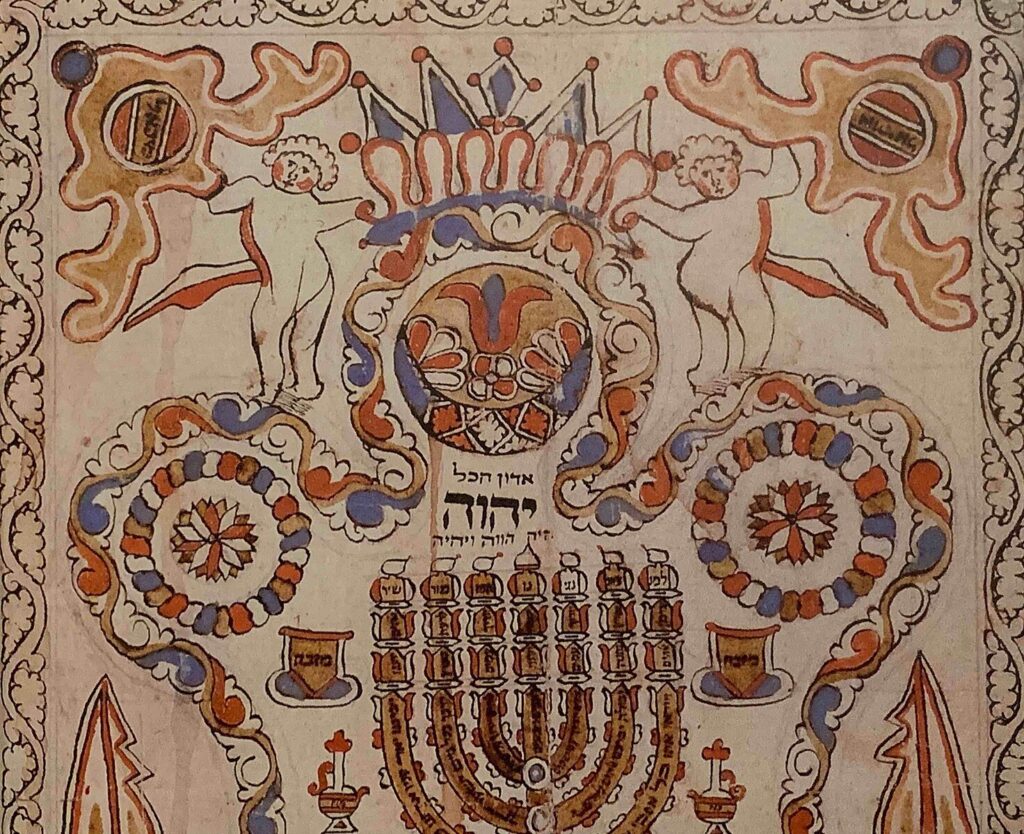
Keter detail of a Kabbalist printing “Mizrach” by Samuel Habib, 1828.