I am overwhelmed by the rapid pace and volume of information we encounter today. Most of it is divisive and sensationalised. It seems that public discourse has shifted from reasoned discussions to polarised shouting matches. Of course, this verbal violence is not new. In the past, heated debates could often turn into violent arguments. However, we are in a unique era marked by technological advancements that allow for instantaneous communication and information sharing without the necessary time to reflect and to ponder. Our brains are not wired to face this constant bombardment of data.
The multiplication of platforms of communication, aka social media, has led to a constant barrage of ideas and opinions that must make their point in an instant, lest they be scrolled down quickly and disappear. Scrolling down and swiping the screen instantaneously have replaced time — time to think, time to reflect, and time to ponder an idea. We react with our emotions and not with our reflection. We either like or dislike things. Some know how to use emotions to promote a hidden agenda, whether political or commercial. They quickly instill ideas or desires through this new form of communication— often without our awareness. We are losing agency. We are losing the ability to think critically and make informed decisions.
This has consequences for our wallets when buying compulsorily. This behaviour is even more dangerous in the political realm. We were citizens of our countries. We have become consumers that need to be fed. Manipulation and propaganda through various media are not new phenomena. The Nazis knew exactly how to use the technology of their time—the invention of the radio at the end of the 19th century opened an era of state-sponsored communication that was very useful for propagating ideas. The advanced technology available today amplifies the reach and impact of state-sponsored communication, making it a widespread phenomenon.
Progress itself is neither good nor bad. It depends on how it is used and for which purpose. Rabelais said in the 16th century, “Science sans conscience n’est que ruine de l’âme” (science without conscience is but the ruin of the soul, Rabelais, Gargantua, 1532).
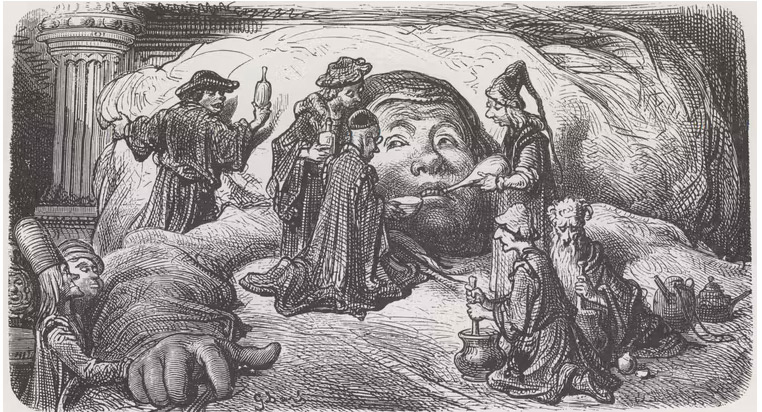
Gustave Doré, Gargantua from Rabelais.
We’ve seen a worrying trend emerging in the past 15 years, a landscape where objective reality hasn’t disappeared but has become increasingly contested. It is an effect of postmodernism, an era in which emotional resonance supersedes factual accuracy; an era where different groups seem to inhabit different realities; an era of institutional distrust towards governments, media and science, fed by an information overload which makes difficult to find and trust reliable sources of information.
Strategic actors deliberately use this new era of post-truth to play with emotions and promote affective and tribal polarisation. Political identity has become so central that accepting facts contradicting some views can be considered a betrayal. We have polarised and atomised our identities, and we now consider objective reality, which has always been difficult to define, as at best subjective.
Hence the feeling that we live in different bubbles, in different realities, and there is nothing left to unite all human beings. The most recent example is what is unfolding at the White House in Washington. There lives and works a man who holds immense power, whose actions influence the rest of the world, and who lives in a fantasised version of the world. He is like a spoilt child who rearranges the blocks of his Lego as he pleases and throws a tantrum when things don’t go his way, using a limited vocabulary. He can publicly humiliate the president of a country at war. Millions of people cheer as he raises trade tariffs or publishes an endless series of increasingly surreal President’s Acts.
That reminds me of a French theatre play written in 1896 by Alfred Jarry, called “Ubu Roi.” Père Ubu, the main character, is grotesque, infantile and tyrannical. It is a biting satire of power and authority, their greed, corruption and absurdity. The main character unleashes his most base instincts: greed, cruelty, and self-interest without conscience or restraint. Tout change, et cependant tout est pareil!
Decay of the truth, deliberate disinformation, leaders who see themselves above the rule of law, greed with no limit. And above all: complacency among millions. These are Ubu-esque times indeed.
How does one resist that? How does one take back control, not in the MAGA sense, but in a real, humanistic and liberal way?
Limiting information intake and social media exposure is the initial act of resistance. I’ve heard so many times, “I’m killing the time by scrolling down,” but beware; time will kill you in the end, so what have you done with your limited number of days?”
Be wary of those “TikTok” experts who pretend to explain the world to you in 30 seconds. There is no shortcut to knowledge. It takes time for reflection, reading, and absorption. There are places in our world where this process of education (from Latin educare, to bring up, rear, or train) is dispensed in a way that allows a deep connection between reality and facts. We must curate our sources.
And how do we communicate with each other? Martin Buber’s concept of the I and Thou creates a space where people can communicate, hear, and consider each other. An ancient piece of wisdom that emanates from the Jewish tradition explains this very well.
Rabbi Abba said in the name of Shmuel, “For three years, the House of Hillel and the House of Shammai argued. One said, ‘The halakha [religious law] is according to our view,’ and the other said, ‘The halakha is according to our view.’ A heavenly voice spoke: ‘Both these and these are the words of the living God, but the halakha follows the House of Hillel.'”
A question was raised: Since the heavenly voice declared, “Both these and these are the words of the Living God,” why was the halakha established to follow the opinion of Hillel? It is because the students of Hillel were kind and gracious. They taught their own ideas as well as the ideas from the students of Shammai. Not only that, but they went so far as to present Shammai’s opinions before their own.
Eruvin 13b
To resist the madness of our world, we must restore calm and quietness. We need to reclaim control of our time and our thoughts. It’s essential that we respect one another, recognising in each person a spark of Divine Light. The resistants of today are those who slow down and allow the hectic flow of modern time to pass by them without being overwhelmed.
Being human means recognising our profound interconnection—we are equal beings, sharing common rights and responsibilities. Throughout our history, we’ve made remarkable steps in defining these shared rights and duties, gradually awakening to what unites rather than divides us.
Yet we remain tribal at heart. We are fixated on the small circle of light immediately surrounding us, often blind to the universal radiance that encompasses all humanity.
The reality is stark and humbling: we are all inhabitants of a single fragile planet, adrift in a remote corner of the Milky Way—just one modest galaxy among billions. This cosmic perspective leaves us with a clear choice.
Either we master the art of coexistence, embracing our shared humanity despite our differences, or we face extinction together. Our collective future hangs in this balance—learning to live as one human family or perishing as divided tribes.