Parashat Vayakhel
Shabbat Vayakhel – 22 Adar II 5785 – March 21, 2025
The Power of Kehillah: The Beauty of Jewish Community
What draws us to belong to a Jewish community? More broadly, why do we feel the need to belong anywhere at all? Each of us exists at the centre of a web of relationships—family ties, friendships, work connections, and volunteer networks—intertwining to shape our lives. Yet, there’s something distinct about being Jewish and choosing to belong to a kehillah, a community. Why does it matter so much?
This week, we read Parashat Vayakhel, the second-to-last portion of the Book of Exodus, occasionally paired with the final portion, Pekudei, in a non-leap year. It’s a parsha about building the Mishkan—the sacred tent where God’s presence would dwell among the Israelites in the desert. The text opens with a powerful moment: “Vayakhel Moshe et kol adat Bnei Yisrael, vayomer aleihem,” Moses gathered the entire community of the children of Israel and said to them, ‘These are the things that the Eternal has commanded you to do’” (Exodus 35:1).
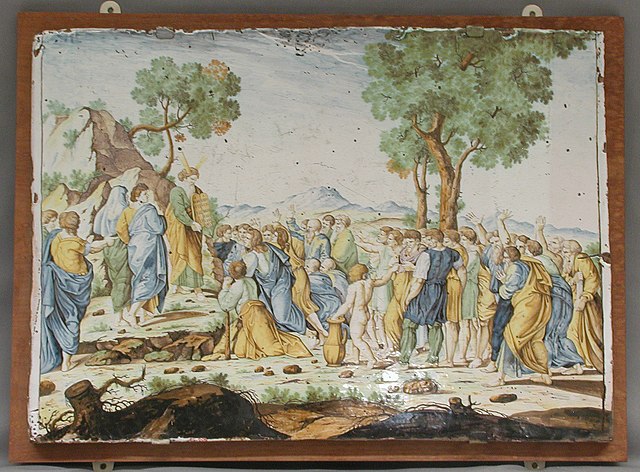
Moses and the Tablets of the Law, attributed to Bartolomeo Terchi, 1720
Two Hebrew terms here illuminate the essence of community. Vayakhel, “and he gathered”, suggests a group brought together, often for a sacred purpose—like worship—or, in other contexts, even for battle, and Edat Bnei Yisrael, “the entire community of the children of Israel”, that evokes a collective that bears witness, a concept echoed in Psalms (82:1): God stands in the “divine assembly”, be’adat El—a community united in purpose and presence. Vayakhel is a story of kehillah—community—and it reveals why coming together as Jews is so vital. Let’s explore three profound lessons from this parsha that highlight the beauty and power of gathering as a people.
1. Everyone Has a Role in the Community
The parsha begins with Moses assembling all the Israelites, and what follows is extraordinary: everyone contributes to building the Mishkan. Some offer gold or silver; others weave fine cloth, and skilled artisans like Bezalel craft the sacred objects (Exodus 35:20-29). Men and women, young and old, rich and poor—all give what they can. This isn’t a task reserved for leaders or the elite; every individual has something unique to bring.
In a kehillah, your distinct skills and gifts are not just welcomed—they’re essential. We’ve all heard that the whole is greater than the sum of its parts, but in a Jewish community, this truth shines brightest. A community is, at its core, its members—each one vital, each one valued.
2. Together, We Create Holiness
Every thread, every plank of wood, and every donation the Israelites brought for the Mishkan became part of something far greater: a dwelling place for God’s presence. When we gather as Jews and work together, we transform the ordinary into the sacred. Think of a minyan—ten people praying together invite God’s presence in a way solitary prayer cannot. Or consider tzedakah, charity as a collective; our contributions lift more lives than any one of us could alone.
Our kehillah doesn’t just build structures; it weaves a tapestry of interconnected souls, linked to each other and to God. Time, effort, even money—these everyday offerings become holy when we give them together. In a Jewish community, we don’t merely coexist; we create a space where divinity can dwell among us.
3. Belonging Strengthens Our Identity
Why did the Israelites need the Mishkan? It wasn’t just a tent—it was a tangible reminder that God was with them, even in the wilderness. By uniting to build it, they reaffirmed their bond with God and with one another. After the fracture caused by the Golden Calf in an earlier parsha, this collective effort was a chance to heal and recommit as a people. It showed that being Jewish isn’t a solitary journey—it’s a shared one.
Today, our kehillah serves the same purpose. When we gather in synagogue, celebrate holidays, support each other through life’s challenges, or rejoice in its milestones, we embrace the richness of being Jewish. Our traditions, our language, our shared history—these connect us to the Israelites in the desert and to generations yet to come. Togetherness reminds us who we are: not just individuals, but links in an enduring chain, a people with purpose and meaning.
So, let’s return to the question: Why do we belong to a Jewish community? What does it add to our identities? For me, it’s about finding a place where every voice matters, where our collective efforts create holiness, and where togetherness roots us in something eternal. These are my answers. What are yours?