
Maidenhead Synagogue, Yom Kippur 5785, 11 October 2024
The other day, after the Tashlikh ceremony on the first day of Rosh Hashanah, I was walking back to the parking lot with one of our members, and we got into a discussion about the content of the prayers we read in the morning. She mentioned that this year, she found it particularly difficult to relate to some of them, especially the ones that claim God will protect Israel from its enemies or provide for all our needs. She added, How can we rejoice at the dawn of a new Jewish year when so many are still held captive in Gaza? Where is the joy? I suppose we all find ourselves occasionally wondering how we relate to the many words we are saying during these High Holy Days. We read and say, or sing, thousands of them, and we never really take the time to stop and think, Do I believe in what I am saying? And if not, why am I doing this?
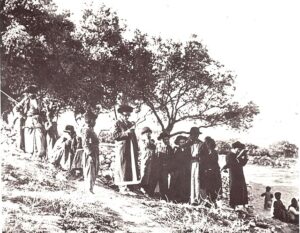
Tashlich, location unknow, 1910s
This tension between words and action, between what we say and what we actually believe, is called, in scientific terms, “cognitive dissonance”. In psychology, the phenomenon of cognitive dissonance occurs when a person holds two or more conflicting beliefs, values, or attitudes. This tension, or contradiction, can lead to feelings of discomfort, unease, or even stress. Sometimes, we have beliefs, attitudes, or behaviours that are inconsistent with each other. The example that is usually given to demonstrate that is smoking or any other type of addiction. We know it’s bad, and yet, we do it. Sometimes, we find ourselves in situations that challenge deeply held beliefs, and we struggle to reconcile what we believe and how we react, finding it difficult to hold the tensions of the opposites when facing a complex problem.
Tonight, I would like to explore a few of these cognitive dissonances that we may find ourselves in, either because it is Yom Kippur or because of the current situation in the wider world.
Let’s go back a moment to this conversation I had with this lovely young lady on our way back to the parking after Tashlikh.
During the High Holy Days, we utter hundreds, thousands of words. How do we reconcile their meaning and their resonance in our inner selves?
The history of Jewish liturgy is long, rich, and fascinating. In short, we, Rabbinic Jews, are using a liturgy that was produced by the Rabbis of old, the Rabbis of the Talmud and the Midrash. They themselves used biblical material, adapted it, and made it relevant for their generations. These Rabbinic texts have aged; sometimes they got better, like a good old wine, and sometimes they got so cryptic that nobody could even pretend to fathom what they actually meant. One of the first tasks of the Reform of Judaism in the 19th century in Germany was to “tidy up” the prayer books, to update their content, to change some of the beliefs into something more acceptable to modern Jews, to shorten services, and to make a larger use of the vernacular language. And our current new machzor is the latest iteration of this work on prayer books undertaken by Reform Rabbis 3 centuries ago.

The first liberal Siddur was published in Hamburg in 1819.
But this mammoth work does not stop us from feeling at odds with the words we are saying. The sudden conflation between the present we inhabit and the past that produced these prayers is the root cause of this cognitive dissonance between our world outside the synagogue and our spiritual experience within its walls. Two hours ago, we were heading over here, maybe listening to the radio or checking our smartphones, and suddenly, we are thrown into a world of words created centuries ago, with a lexical field of words echoing a cultural reality that is not ours anymore. It feels as if we’ve entered an ancient, yet familiar space, and we need some time to adjust.
However, being Jewish does not mean to believe blindly in every single word of our tradition. Being Jewish implies questioning everything that is in this tradition, being in dialogue with past generations, acknowledging them, and acknowledging their uniqueness, while accepting the uniqueness of our generation and its particular needs. We received a tradition, and we will transmit it to the next generation, but we will take from it what makes sense here and now and not necessarily what made sense in Israel in the 1st century of the common era. As the French philosopher Jacques Ellul once said, “Prayer holds together the shattered fragments of the creation.” We hold our own fragments today, as our descendants will hold theirs tomorrow. They are not the same, but they are part of the same multivocal tradition of Israel. In addition to that, we shouldn’t forget that the words we are using for and calling prayers are not meant to change the mind of a distant deity. They are a help, a support, almost a mirror that this deity has placed before us to undertake our own change, our own teshuva, or return. The first dialogue we are invited to open today is with us: where am I? What am I doing with my life? Am I congruent with my values? What needs to change?
I’d like to explore now another cognitive dissonance that is not directly connected to Yom Kippur but that emerged a year ago, during last year’s Yamim Noraim, last year’s Days of Awe; more precisely, last year’s Simchat Torah. On Monday evening, we gathered at the synagogue to mark the first anniversary of the 7th of October. I wasn’t sure what to expect: half a dozen? 2 dozen? The room was full, as was the online gathering I’d organised earlier that day. Many people told me afterwards how appreciative they were for this opportunity to come together and how needed this gathering was. We needed to come together as a community to remember what happened last year. We needed to come together to feel that in the face of adversity, our community is one. And we needed to come together as a community to express our feelings and to be heard by people who would understand without having to explain or justify. It was hard, harrowing even, and I had to hold back my tears more than once. But it was good, so good; it was cathartic. One member, the daughter of a Holocaust survivor, stood up and said with much passion, “It is enough; they tried to harm us so many times, in so many ways, but we are here to stay.” Another member, who is Israeli, spoke about her life growing up in the West Bank, how in her community they live peacefully with the Palestinians in the neighbouring village. Many expressed their sadness and their worries, but also the strong resilience of the Jewish people and the certainty that gam zeh ya’avor, this too shall pass.
As a people which places ethics at the core of its values, we are torn between the horrors that our brethren suffered in southern Israel, the anguish of the 101 hostages still held captive, the suffering of the 60,000 displaced people in the north of the country, and, at the same time, the violent war that is raining down upon innocent victims in Gaza and in Lebanon. We know that Israel has probably no other choice than to show its strength, even if we wonder, Isn’t it too much? We know that the enemies of Israel are the enemies of all Jews and of the West, and they will never halt, unless stopped forcefully. We know that behind this widely spread anti-Israel sentiment, antisemitism is not far behind; this old multifaceted prejudice. And we wonder, ad matai, until when? We are torn between the Jewish ideal of peace, equality, and universal sanctity of human life, and the fact that the war goes on, with its cortege of violence and suffering, with no signs of abating. Regardless of the justifications for its waging, war invariably results in wounds, suffering, and death. The cognitive dissonance here resides in the fact that we know that we are all humans, that we share the same rights to dignity and life, because, as our Scriptures say, we were created b’tzelem Elohim, in God’s image; each of us, regardless of their origin, holds a tiny spark of the divine. But in a time like this, this sounds pretty naïve. But remember, if the voice of weapons can change the fate of nations, it is only the voice of the visionary, the voice of the dreamer of a better world that can change the fate of humankind.
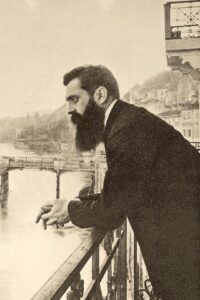
Theodor Herzl on the balcony of the Three Kings Hotel in Basel, 1898, first World Zionist Congress.

Maybe that is the true meaning of Yom Kippur. Surrounded by many members of the community, yet alone with our own thoughts, we are asked, Examine your ways; see if a better “you” is possible. See if you can participate in the healing of the world by healing yourself first.
A great sage of the Mishnah, Rabbi Hillel the Elder, who lived in the first century of the common era, summarised so beautifully the human condition: “im eyn ani li, mi? If I am not for me, who will be for me? U’ch’she ani le atzmi, ma ani? And if I am for myself alone, what am I? V’im lo achshav, eymatai? And if not now, when?” (Pirkei Avot 1:14). Healing on Yom Kippur begins with the self, but it is only a first step to heal the world. It may feel sometimes like a hopeless task. That is why we are doing this together today, surrounded by members of the community.
And if you are tempted to judge yourself too harshly, or if you believe that whatever you do and say, you are beyond redemption, let me share again a story that I told you on the eve of Rosh Hashanah. The students of the Baal Shem Tov, the founder of Chassidism in the 18th century, asked him once how to prepare for the High Holy Days.
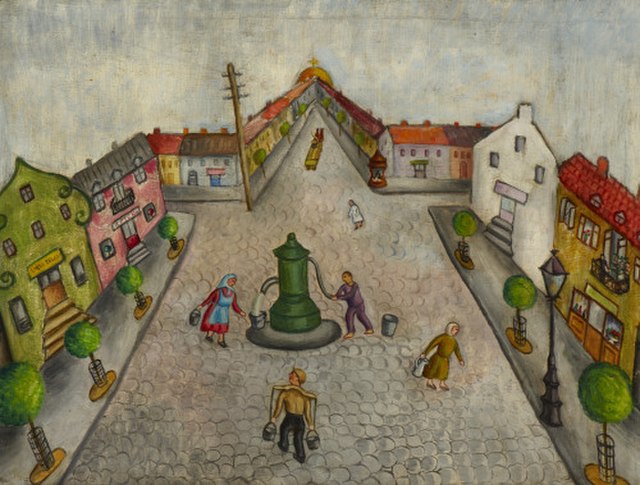
Chana Kowalska Winogora, The Shtetl, 1934.
He sent them to observe a simple innkeeper, Moishe. At midnight, before Rosh Hashanah, they saw Moishe taking down two large notebooks from the shelves. He sat down on a small stool, lit a candle, and began to read from the first notebook. It was a diary of all the misdeeds and transgressions he had committed during the year, with exact times and circumstances. They were quite minor transgressions: a bit of gossip, oversleeping instead of going to the synagogue for the morning service, and yet, as he was reading, Moishe wept until the last page was turned. He then opened the second book. This too was a diary of all the troubles and misfortunes that had befallen him during the year, the day he was beaten by a gang of peasants, the day his son broke his legs, or the long winter the family had no wood for their fire.
When he finished reading, he lifted his eyes heavenward and said, “You see, dear father, last year, I have sinned against You. Last year, I repented and promised to fulfil all your commandments, but I repeatedly succumbed to my evil inclination. But last year, I also prayed for a year of health and prosperity, and I trusted You that it would indeed be this way. Heavenly Father, today is Rosh Hashanah, when everyone forgives and is forgiven. Let us put the past behind us. I didn’t always do what was asked of me. You didn’t always do what was asked of you. I forgive you, and you forgive me, and we’ll call it even”.