
A reflection on the double portion of B’har-B’chukotai
Maidenhead Synagogue – 8 May 26
The Torah portion this week teaches us how to walk through difficulty without losing our souls. A single question runs from one end of the parasha to the other: when relationships are uneven, when people depend on one another, when pain is real and information is incomplete, what kind of community will we become?
We live in anxious times. The pressure of the news, reports of rising antisemitism, and the sense that the ground is shifting under our feet: all of this asks something of the soul. When the world feels precarious, we become quicker to fear, quicker to defend, and quicker to interpret. We hear a sentence, or a silence, or a decision, and we begin to fill in the gaps. Anxiety wants certainty. When we feel unsafe, we reach for a story that will make sense of what is happening, tell us who is responsible, and give us somewhere to place our fear.
Judaism understands this instinct and treats it with caution. The first version of any story can be sincere, yet sincerity is not the same as completeness. A partial truth remains a partial truth. Pain deserves to be heard, and pain alone can rarely carry the full weight of judgement.
B’har takes us into the world of land, debt, labour, poverty, dependence and release. It speaks of the sabbatical year, the Jubilee, the return of ancestral land, and the obligations we have when someone becomes economically vulnerable. The parasha treats holiness as a way of structuring relationships. At the centre of its ethical teaching stands a verse that has shaped the Jewish moral imagination for two thousand years:
“Do not wrong one another, but be in awe before your God.” (Leviticus 25:17)
On the surface this belongs to the world of commerce and fairness. Do not exploit. Do not take advantage. Do not use another person’s vulnerability for your own gain. The Rabbis, however, read the verse more deeply. In Bava Metzia 58b they observe that the Torah has already addressed financial wronging a few verses earlier and ask what kind of wronging is meant here. Their answer is ‘ona’at d’varim’, wronging someone with words.
This is a remarkable expansion of the verse’s plain meaning. A community can harm someone with money, with contracts, with power, with exclusion. A community can also harm someone with speech. Words preserve dignity or take it away. Words open a path to repair or make repair almost impossible. Words bring people close or harden suspicion into certainty.
The closing phrase of the verse, “be in awe before your God”, is essential here. The Rabbis often hear that phrase as a marker that something is hidden from other people. Others may not know whether a comment was meant to help or to wound or whether we are speaking from care, anger, fear, loyalty, or pride. God knows. When we speak about one another, especially when people are vulnerable, we should speak as though something sacred is listening.
This brings me to a story in the Talmud, in tractate Shabbat 127b. The Rabbis introduce it with a principle: hadan lekhaf zerut, one who judges another favourably is judged favourably in turn.
A worker from the Upper Galilee goes down to the south and labours for a landowner for three years. On the eve of Yom Kippur he asks for his wages so that he might go home and feed his wife and children. It is a deeply human request: payment for what he has earned, after three years of work, on the holiest day of the year, so that he can return to his family with something in his hands.
The employer says: I have no money.’ The worker asks for produce. The employer says: I have none.’ He asks for land, animals, even pillows and bedding. The answer each time is the same. Nothing.
If we were watching from the outside, what would we think? We might see cruelty. We might see injustice. The visible facts would seem to point in one direction. Three years of labour, the eve of the holiest day, and a worker sent home empty-handed.
The worker does something extraordinary. He goes home. He is disappointed. He is unpaid. He is still in need, and the story does not erase that pain. Yet he keeps the question open, waiting for the whole story before allowing his disappointment to settle into certainty.
After Sukkot the employer arrives with the wages and with gifts. He then asks his worker: when I told you I had no money, what did you suspect? The worker answers: I thought perhaps your money was tied up in business. When I said I had no produce? Perhaps you had not yet paid the appropriate tithes. No land? Perhaps it was leased to others. No animals? Perhaps they were hired out. No pillows or bedding? Perhaps you had consecrated them to Heaven.
The employer confirms that this is precisely what had happened. There was more to the story than could be seen from the outside. He blesses the worker: as you judged me favourably, may God judge you favourably.
The story is easily misread. The restraint it teaches concerns the inner work of judgement; the outward demand for justice remains intact. The worker was still owed his wages. The employer still had to return, explain, and pay. Jewish ethics treats pain as real and recognises that explanations are different from excuses.
The story teaches the holiness of restraint, and the teaching is subtle. There is a spiritual difference between saying, “I am hurt,” and saying, “Therefore, I know the whole truth.” There is a difference between listening to someone’s pain and turning a partial account into a final judgement. There is a difference between caring and condemning.
Every community faces moments when feelings run high. Every community has seasons when people are hurt, anxious, loyal, confused or afraid. In those moments, stories travel quickly. A sentence becomes a report. A report becomes a judgement. A judgement becomes a camp. Before long, people who once trusted one another begin to look at one another through the narrowest possible lens.
The Torah’s warning against wronging one another then becomes urgently relevant. We can wrong one another by deciding too quickly what another person has done. We can wrong one another when we repeat what we have not verified. We can wrong one another when we make no space for complexity. We can wrong one another when we forget that every person involved in a painful situation is still created in the image of God.
Listening must be joined to humility. We can hold concern while resisting the rush to certainty. We can care for someone who feels wounded while preserving someone else’s dignity. We can ask for accountability without abandoning compassion. We can protect a community while refusing to set its members against one another.
And so we arrive at B’chukotai, which opens with a striking verb:
“If you walk in My statutes…” (Leviticus 26:3)
The Torah could have said: if you obey, if you keep, if you fulfil.’ Instead, it says, ‘If you walk.’ Jewish life is imagined as a walk. A walk is steady, attentive, and ongoing. It allows for difficult terrain. It permits us to keep moving even when the road is uncomfortable.
A holy community, perhaps, is one that knows how to walk through difficulty without losing its soul. It is a community where pain can be spoken without being weaponised, where loyalty is honoured without becoming blindness, where leaders are held accountable without being dehumanised, where those who feel hurt are held with tenderness, and where those who are accused retain their dignity until the facts are known. It is a community that remembers that truth is served by patience and fairness as much as by speed.
The worker in Shabbat 127b did not know the whole story. He had every reason to feel hurt. He left room for another part of the story to come into view, and because of that, the story ends with blessing.
May we learn to do the same. May our words be careful, our judgements measured, our loyalty joined to wisdom, and our pursuit of justice joined to compassion. May our community always be strong enough, gentle enough, and faithful enough to walk together, even when the path is difficult.
Shabbat shalom.
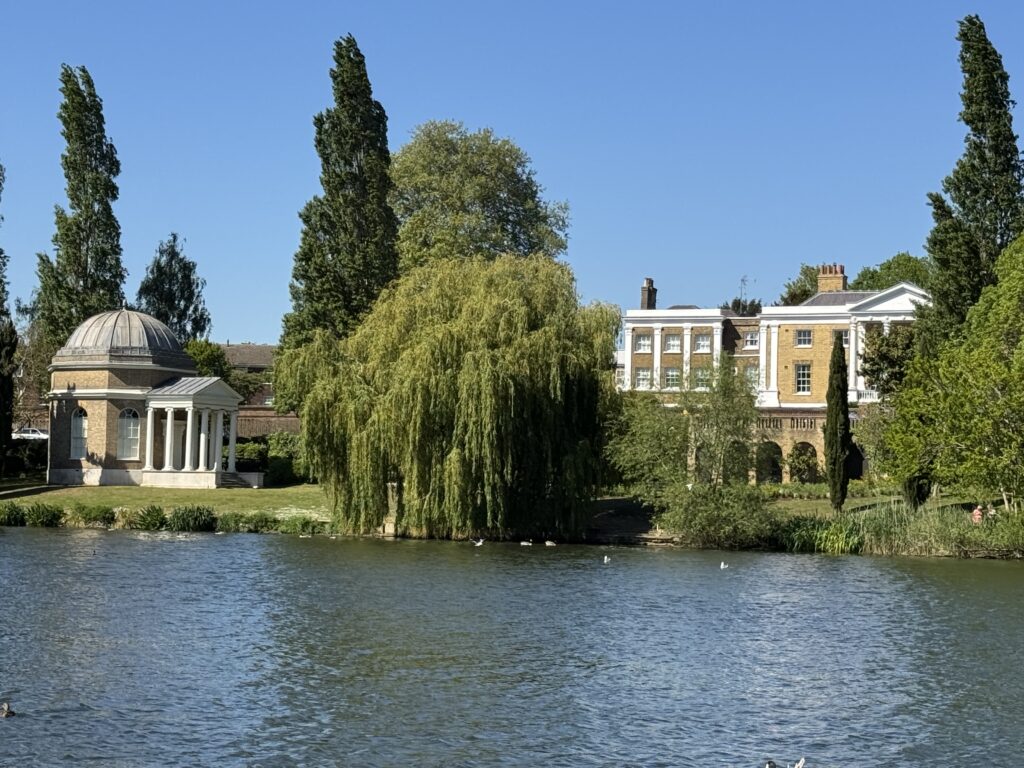
I live by the river Thames, near Hampton Court. That’s a photo of the Garrick’s Temple, a place of quietness; the rive