
Erev Rosh Hashanah 5786 / Monday 22 September 2025
My friends, I want to begin this sacred day with a confession and a promise.
The confession first: I will not speak to you today about Israel and Gaza. I will not touch upon the great challenges of our time that dominate our news feeds and our dinner table conversations. Not because they don’t matter – they matter enormously – but because I believe there is nothing new to say. The script has been written, the lines have been drawn, and we find ourselves stuck in conversations that create more heat than light, more division than understanding.
The promise: As a rabbi, I want to take you all with me, regardless of your views or mine. That’s what being a rabbi means to me: not to be the voice of one perspective, but to be a guide for our collective journey towards something higher, something deeper, something truer than the categories that usually separate us.
Today, as we gather for Rosh Hashanah, I find myself thinking about scripts, the ones written for us, the ones we write for ourselves, and the courage required to step away from both when they no longer serve the truth of who we are. We live in a time when it feels as though every conversation has already been scripted, every response predetermined. The script is handed to us before we even open our mouths.
Instead of ruminating on the same issues that have consumed us for months and years, I want to propose something different for these Ten Days of Awe. Let’s try to figure out how we can renew ourselves before worrying about the rest of the world. Rosh Hashanah is, after all, about renewal. It is called in our tradition ‘yom harat olam’, the birthday of the world, the day when creation begins again.
I believe deeply that the world needs renewal. Not the tired solutions currently on offer, not the same arguments dressed up in new rhetoric, but a renewing sense of what it means to be human, with what I call the Jewish touch. Our tradition offers something unique to this conversation, something that transcends the political categories that have hijacked so much of our attention and our energy.
Without naivety, I want hope. Without cynicism, I want to discover a way forward. Without the unnecessary and hurtful divisions that have marked these past years, I want to embrace the full diversity of humankind. This is my offering for you over these Days of Awe: a new message grounded in our most ancient wisdom.
Because here’s what I’ve discovered: when we focus first on renewing ourselves, when we do the patient work of becoming more fully human, more genuinely compassionate, more authentically wise, that’s when we become capable of contributing something meaningful to the world’s healing. But when we start by fixing everything else while remaining oblivious to our own limitations, we usually end up adding to the world’s problems rather than solving them.
Our ancestors understood this. They gave us these days not as a time for external activism, but as a season for internal transformation. They believed that changed people change the world, that renewed souls renew societies, and that individuals who have done the work of genuine teshuvah become agents of repair in ways that those who skip this inner work cannot.
So today, and in the days that follow, I invite you to step with me beyond the script. Beyond the predetermined responses and predictable positions. Beyond the exhausting cycle of outrage and counter-outrage that characterises so much contemporary discourse, I invite you to remember what it means to be a human created in the image of God, what it means to be part of a tradition that has always insisted on the possibility of transformation, and what it means to be a people who look at the world as it is and dare to imagine it as it could be.
This is not escapism. This is preparation. This is the work that makes all other work possible. This is how we find our way back to hope, back to wisdom, back to the kind of relationships that can hold genuine difference without breaking.
And it begins, I believe, with something as simple and as profound as learning to wonder again.
Here’s what I want to suggest to you today: we are Jews. And if there’s one thing our tradition has taught us across millennia, it’s that we don’t have to accept the scripts others write for us. We have another choice entirely; we can choose wonder.
And I believe, among the rituals and laws of Rosh Hashanah, there is one that calls us to write our own script, one that reminds us that our history is a series of wonders that have shaped who we are and what we are today.
The Torah mentions Rosh Hashanah as a day of teruah, a blast or alarm. On this day, we will hear one hundred blasts of the Shofar: long blasts – tekiah –, short bursts – shevarim –, and trembling calls – teruah – that seem to shake something loose in our souls. Why do we need so many when the Torah mentions only one, teruah?
The Talmud offers us a curious answer. In Rosh Hashanah 16b, it is said that this diversity is “in order to confuse the Satan” (l’arbev et haSatan). You might wonder what Satan has to do with anything, especially if you’re not particularly inclined towards supernatural thinking. But let me suggest that Satan here represents that voice that tells us nothing is remarkable anymore, that life is ordinary, and that wonder is for children and fools.
The shofar exists to confuse that voice. To break through what I can only call our spiritual numbness, the way we sleepwalk through miracles, the way we become so accustomed to being alive that we forget how extraordinary that really is.
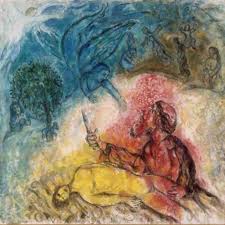
Think about Abraham for a moment, standing on Mount Moriah with his son Isaac. The midrash tells us that just as he raised the knife, he heard a sound: a ram caught ba-s’vach in the thicket. That word, s’vach, doesn’t just mean ‘thicket’. It means entangled, caught up, enmeshed. The ram was trapped in a web of thorns and branches, unable to see clearly, unable to move freely, just as we are when we are numb to the wonders of the world.
Aren’t we all caught in thickets of our own? Enmeshed in routines that have become so automatic we no longer see them? Entangled in worries and obligations that prevent us from noticing the ram, the alternative, the miracle, the possibility, right in front of us?
We’ve all had moments when something ordinary suddenly reveals itself as extraordinary. A tree catching morning light in a way that transforms its leaves to gold. A stranger’s kindness that arrives precisely when we need it most. A piece of music that somehow speaks directly to our soul. These moments cut through our routine and remind us that the world is far more remarkable than our daily preoccupations allow us to see.
The prophet Elijah experienced something like this. After the earthquake and the fire and the great wind, after all the dramatic external events, he heard the kol d’mamah dakah, usually translated as “a still, small voice”.
This is the voice that calls us beyond the script. Beyond the predetermined responses that trap us in cycles of reaction and counter-reaction. Beyond the certainties that prevent us from growing.
But here’s what the tradition understands that we often forget: wonder isn’t passive. It’s not just about feeling grateful for pretty sunsets or appreciating nature. Wonder is active. It’s a way of engaging with the world that transforms both us and everything we touch. Wonder is what allows us to step outside the scripts that others have written for us and to write new ones.
When we approach our relationships with wonder, we stop taking people for granted and start seeing them as the complex, fascinating, irreplaceable beings they actually are, even when we disagree with them profoundly. When we approach our challenges with wonder, we stop seeing them as obstacles that prove the world is broken and start seeing them as opportunities to discover strengths we didn’t know we possessed. When we approach our differences with wonder, we stop seeing them as threats to be eliminated and start seeing them as invitations to expand our understanding.
So how do we cultivate this? How do we create what I’m calling “shofar moments” throughout the year?
First, we practise what I call sacred interruption. Set aside time each week; it doesn’t have to be long to deliberately break your routine. Walk a different route. Eat lunch somewhere new. Call someone you haven’t spoken to in months. Pay attention to what you notice when you step outside your habitual patterns.
Second, we ask different questions. Instead of “How was your day?” try “What surprised you today?” Instead of “Did you finish your homework?” Ask, “What was the most interesting thing you learned?” Instead of focusing on productivity, focus on discovery.
Third, we practice gratitude for the specific rather than the general. Don’t just be grateful for family, be grateful for the way your partner makes coffee in the morning, for the sound of your child’s laughter when they think no one is listening, and for the text message from your friend that arrived exactly when you needed it.
The great Jewish philosopher Abraham Joshua Heschel wrote, “Wonder or radical amazement is the chief characteristic of the religious man’s attitude toward history and nature” (God in Search of Man: A Philosophy of Jewish Religion, New York: Farrar, Straus and Giroux, 1955, p. 46). Our goal, he suggests, should be to live with this radical amazement, to wake up each morning astonished that we exist at all, that there is something rather than nothing, that we have been given another day to participate in the ongoing creation of the world.
This isn’t about naive optimism. Life contains genuine hardship, real pain, and profound loss. But even in the midst of difficulties, wonder can be a form of resistance. It’s a way of saying that we refuse to let circumstances diminish our capacity to be amazed by the sheer fact of being alive.
The shofar calls us back to this. It reminds us that before we can do teshuvah, we first need to remember what it feels like to be awake. To be present. To be amazed.
As we listen to the shofar today, let it cut through whatever thicket of habit and routine has entangled you. Let it cut through whatever script of cynicism or despair has been written for you. Let it remind you that you are a participant in the most extraordinary story ever told, the story of consciousness awakening to itself, of beings capable of wonder contemplating the wonder of their own existence.
The ram was caught in the thicket, but it was also available for redemption. So are we. The question is whether we’re listening for the sound that will set us free from the predetermined responses that prevent us from addressing our challenges creatively.
This is how renewal begins. Not with grand gestures or dramatic pronouncements, but with the simple, radical act of choosing wonder over cynicism, amazement over indifference, and curiosity over certainty. This is how we step beyond the script and begin to write something new.
Shanah tovah u’metukah. May this be a year of renewed wonder, of radical amazement, of eyes opened wide to the magic that surrounds us every single day.
Let the sound of the shofar awaken us. Let it call us to wonder.