
Historically, Jews could read and fit into the political landscape with some clarity: the far right was hostile (with its explicit antisemitism), while liberal and left spaces offered refuge and solidarity. Conservative spaces were more complex, sometimes welcoming, sometimes not. But at least the map was readable, and despite the large variety of political views within the Jewish community,
Today, things are far from being obvious. On the right, you find some of Israel’s strongest supporters sitting alongside people who still hold ancient antisemitic conspiracy theories. On the left, spaces that once embraced Jews as part of the coalition of the marginalised, now sometimes view Jewishness itself with suspicion, as if it were inherently aligned with power and oppression.
This isn’t just about Israel/Palestine, though that’s often the starting point. It’s about a deeper shift in how identity, power, and oppression are understood. When you’re viewed as “white and privileged” in progressive spaces but still targeted by white supremacists and fascists, who see you as fundamentally other, where do you belong? When your history of persecution is dismissed as irrelevant because of perceived current privilege, how do you find solidarity?
There may be today a sense of being politically homeless, too concerned about rising antisemitism to feel comfortable in spaces that minimise it, but too committed to values of equality and justice to align with movements that compromise those principles. The old certainties – “we belong here, not there” – have dissolved.
Perhaps what’s emerging is a recognition that Jews, like many groups, need to rethink who their allies are and to build coalitions issue by issue rather than finding a permanent political home. But that’s exhausting and isolating in a way that previous generations didn’t experience.
Two books helped me begin to make sense of this:
Yascha Mounk’s The Identity Trap (2023), which explores how identity-based movements, though born from good intentions, can sometimes morph into exclusionary ideologies.
David Baddiel’s Jews Don’t Count (2021), a sharp, personal reflection on how antisemitism is often overlooked or minimised within progressive circles.
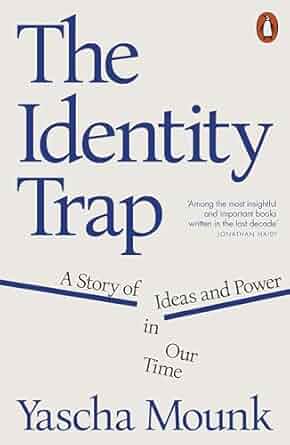

Taken together, these books highlight the paradox many Jews feel today: how a community historically oppressed and linked to struggles for justice now finds itself pushed to the margins of progressive discourse.
Yascha Mounk’s analysis of identity politics illuminates why Jews have become politically homeless in contemporary Western democracies. His critique extends far beyond the Jewish question, though. He demonstrates how identity politics fractures liberal democracy itself, undermines solidarity across groups, and makes universal coalition-building impossible. Jews represent one particularly clear example of this systemic problem, alongside working-class white people who lack privilege but get coded as oppressors because they are identified as “white”.
Within Mounk’s framework, the shift from longing for universal human rights to organising politics around fixed identity categories creates impossible binaries. Jews are the perfect example of this problem: too successful to be oppressed, too historically persecuted to be oppressors. Their political homelessness is diagnostic of a larger crisis in some parts of the political spectrum, the abandonment of universalism for a rigid identity hierarchy that ultimately serves no one well.
David Baddiel’s observation that “Jews don’t count” provides the lived evidence of Mounk’s theoretical framework. His phrase isn’t just a complaint but an observation about how progressive anti-racism operates in practice. In the hierarchy of oppression that shapes contemporary discourse, antisemitism is uniquely minimised, seen as less serious than other forms of hatred, historical rather than current, and a problem of the right but never the left. Jews are the only minority told their concerns about racism are actually a cynical way to protect power. No other minority faces demands to denounce their ancestral homeland as a prerequisite for acceptance.
Jews have become pawns in others’ ideological games. The political far-right embraces Israel to advance their nationalist, anti-Muslim agenda, and at the same time, they don’t espouse the values that underpin Judaism. The left invokes Jewish ethical teachings, tikkun olam, and justice for the stranger and argue that Jews have now become what they have been suffering from for centuries. Both use Jews as symbols rather than seeing them as complex human beings navigating very difficult choices.
The framework of social justice activism fails catastrophically with Jews. Perceived as privileged, attacks on Jews get reframed as speaking truth to power rather than perpetuating ancient hatreds. When Jewish institutions require security guards, when European Jews remove mezuzahs from doorframes, and when synagogues face graffiti and firebombs, these are not seen as the civil rights issues they would be for any other minority.
Contemporary progressive discourse struggles with Jewish complexity. Jews are an ethnoreligious people encompassing Ashkenazi, Sephardi, Mizrahi, Ethiopian, and other communities. They include people who are visibly white, Black, and brown. Binary thinking about ethnicity doesn’t apply to Jewish communities.
The same movements that validate “lived experience” selectively ignore Jewish experiences. Palestinian narratives are treated as authentic; Jewish fears of antisemitism are dismissed as manipulative. When Jews raise concerns about anti-Semitic rhetoric hiding behind anti-Zionism, they’re accused of “weaponising” antisemitism to silence legitimate criticism. Students who identify as Jewish report feeling unsafe on campuses, only to have their concerns dismissed if they do not denounce Israel’s existence. This double standard, in which the concerns of every other minority about hatred are taken seriously while Jewish concerns are scrutinised for ulterior motives, reveals that Jews simply do not count in the progressive moral universe.
This creates a series of false binaries that trap discourse. Jewish values properly understood include: Justice (tzedek) includes justice for Jews as well. Repair of the world (tikkun olam) doesn’t require Jews to be broken. Love for the stranger (ahavat ger) acknowledges that Jews were once strangers as well.
Such stances make space for Palestinian dignity without erasing Jewish needs, critique Israeli policies without denying Jewish legitimacy, and hold multiple truths without collapsing into relativism. These positions will never achieve ideological purity. They’re too sympathetic to Palestinian suffering for hardline Zionists and too accepting of Jewish legitimacy for anti-Zionists. But this is precisely what makes them “good enough” in politics. Good enough means accepting that answers need not satisfy every ideological camp completely. That’s their virtue. The impossible perfection of pure positions leaves no room for actual humans to coexist; the productive imperfection of “good enough” creates space for both peoples to breathe.
The humanist tradition sees particular identities within universal dignity. Liberalism knows minority rights require strong democratic institutions. Authentic progressivism fights oppression without creating new hierarchies. Traditional socialism understands economic justice cannot be built on ethnic hatred.
Political homelessness results not from confused values but from institutions that have lost their way. Jews are the canary in the coal mine for a political philosophy that fragments rather than unites.
Until political movements recognise that human dignity is indivisible, acknowledge that Jews are part of the human story, and understand that complexity is not betrayal, the political landscape will continue to use Jews as pawns and scarecrows.
This is where Judaism and humanism meet: in the insistence that we are all interconnected, that none is free until all are free, and that this “all” includes Jews. In the acceptance that positions need not be perfect to be worthy, that good enough is indeed perfection when it leaves room for others to breathe. Until Jews count in progressive politics as fully as any other minority, until all who don’t fit neat categories find their place, the movement’s claims to universal justice remain incomplete.