I would like to start with a question that came to my mind when I heard this morning about the attack launched by Israel against Iran’s nuclear facilities. I personally believe it’s an act of self-defence. Iran doesn’t hide its hatred of Israel, and its main goal is to destroy the Jewish State. But I am not here to talk about international politics. I want to read this story through the lens of the Jewish tradition.
My question is: why do we need enemies to thrive?
Why is it that we so often seem to need enemies to feel purposeful and focused, united even?
Throughout history, enemies have provided clarity: a model against which to define ourselves, a reason to mobilise, and a story to tell. Opposition brings cohesion, righteousness, and meaning. But at what cost?
What happens when the enemy becomes central not just to politics, but to identity? When remembering what they did to us becomes the very thing that prevents us from moving forward?
In a moment like this morning, when we hear of the attack against Iran, the arch-enemy of Israel, we often retreat into familiar narratives, seeking comfort in certainty. Yet Torah invites us to pause and reflect more deeply.
We read in our portion:
“We remember the fish that we used to eat free in Egypt… Now our gullets are shrivelled. There is nothing at all! Nothing but this manna to look to!” (Numbers 11:5–6)
This complaint emerges from trauma. The Israelites, freed from slavery and supported by divine providence, begin to moan. But they don’t just say they’re hungry. They construct a fantasy about Egypt, remembering “free” fish and forgetting the cost: their freedom. In the wilderness, they romanticised their past. This isn’t just ingratitude. It’s a psychological truth. When the present is difficult, we retreat into imagined pasts that soothe us more than they instruct us.
This passage is a meditation on memory and liberation. It speaks urgently to a world where cycles of trauma repeat across generations and continents.
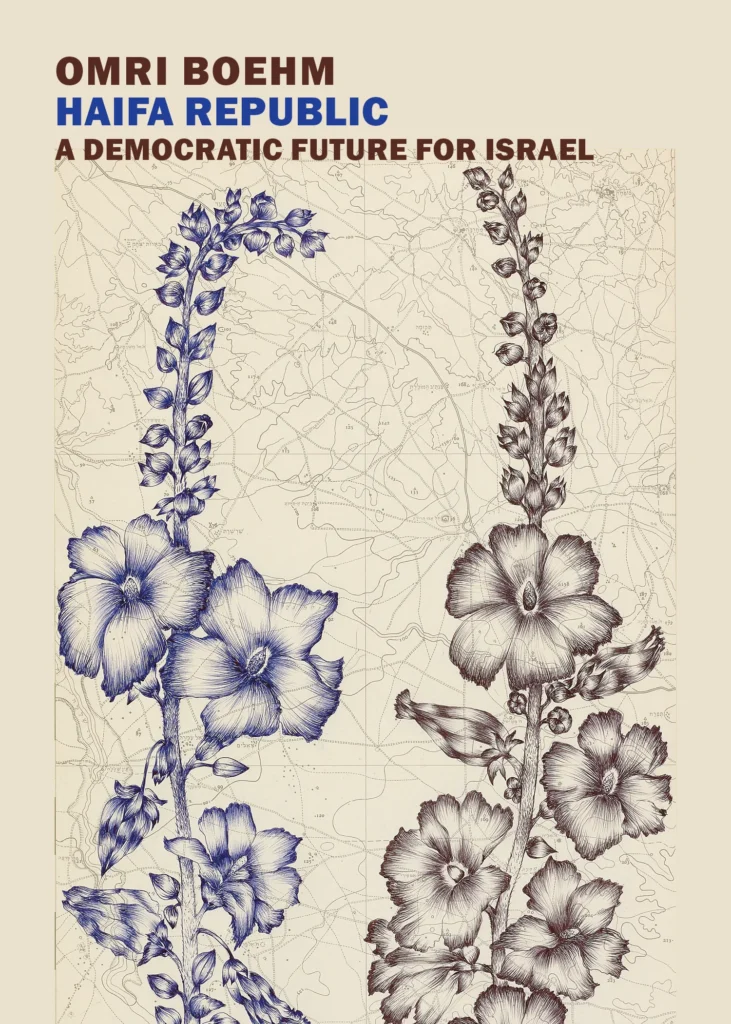
The Israeli philosopher Omri Boehm, in “The Haifa Republic” (2021), argues that both Israelis and Palestinians are trapped in patterns of memory. Both have built narratives around past trauma that, while true, are obstacles for a shared future.
Two Peoples, Two Egypts
In the wilderness, the Israelites longed for Egypt, not out of nostalgia for slavery, but from fear of the unknown. Egypt became a symbol of a painful past distorted by discomfort in the present.
Today, both Israelis and Palestinians carry symbolic “Egypts”: for Jews, the Holocaust; for Palestinians, the Nakba. Each memory reflects real suffering, but each has become a kind of prison, used not just to remember but to define what’s possible now.
For Israelis, the Holocaust has become what Boehm calls “Holocaust messianism”, placing Israel beyond moral critique. For Palestinians, the Nakba, the displacement and dispossession in 1948, remains unacknowledged and unresolved.
Boehm explains that these traumas are real, but the way they function politically blocks progress. They cannot be denied, but they must be remembered differently. He cites a Palestinian Knesset member who stayed silent about the Nakba on Yom HaShoah, in solidarity. This is “remembering to forget”: acknowledging trauma while refusing to let it control the present.
The Manna We Despise
God gives the Israelites manna, that is bread from heaven, and yet they reject it. It doesn’t match their fantasy of Egyptian abundance. Manna is the imperfect but real provision of the present. Apparently, not enough for them. In a case of fantasized past, the present cannot be enough
That begs the question, what is today’s manna? Perhaps it’s the reality that both peoples are now indigenous to this land. Both seek security, dignity, and a future. Neither is going anywhere. Exclusive claims must give way to shared responsibility.
But this “manna”, the imperfect coexistence, is often rejected because it doesn’t fulfil fantasies of total return or complete justice.
The Courage to Remember and Forget
Boehm calls for “remembering to forget”, a way of honouring trauma without being paralysed by it. Jews must remember the Holocaust not as eternal victimhood but as a moral call to protect others. Palestinians need acknowledgement of the Nakba, but both peoples must stop using trauma for political purposes.
This doesn’t mean erasing identity or pain. It means shifting from competitive victimhood to shared responsibility. The Israelites couldn’t reach the Promised Land while yearning for Egypt. We too must build something new, not recreate an idealised past.
Memory as Service, Not Prison
The Torah commands memory: the Exodus from Egypt, the stranger we must protect, because we were strangers in Egypt, of the many oppressions our people has suffered throughout history. But there’s a difference between memory that inspires justice and memory that imprisons.
In other words, a healthy memory asks, “What did our suffering teach us?” and an imprisoning memory asks, “What does our suffering entitle us to do?”
The Israelites’ complaints use memory to justify them and resist change. The Torah calls us to a liberating memory, one that drives compassion and justice.
Building in the Wilderness
The Israelites had to build a society in the wilderness, between slavery left behind and a promise not yet fulfilled. That meant provisional arrangements, imperfect structures, and hard work, without having any idea of what may lie ahead. And these are the questions that are asked to us in the Torah: How do we build without looking backward? How do we strive for justice when caught between loss and aspiration?
May we find courage—to honour the past without being held hostage by it, to embrace imperfection in pursuit of justice, and to choose hope even when history seems doomed to repeat itself. The past tells us who we are and why we are the people that inhabit the world today. But we cannot allow the past to dictate our future.
Maybe the fundamental teaching of the Exodus that we celebrate during Pesach is not only a people that travels from slavery to freedom but also a people that is able to leave trauma behind, spending some time in a sort of wilderness, and coming out to build a fair and just society?
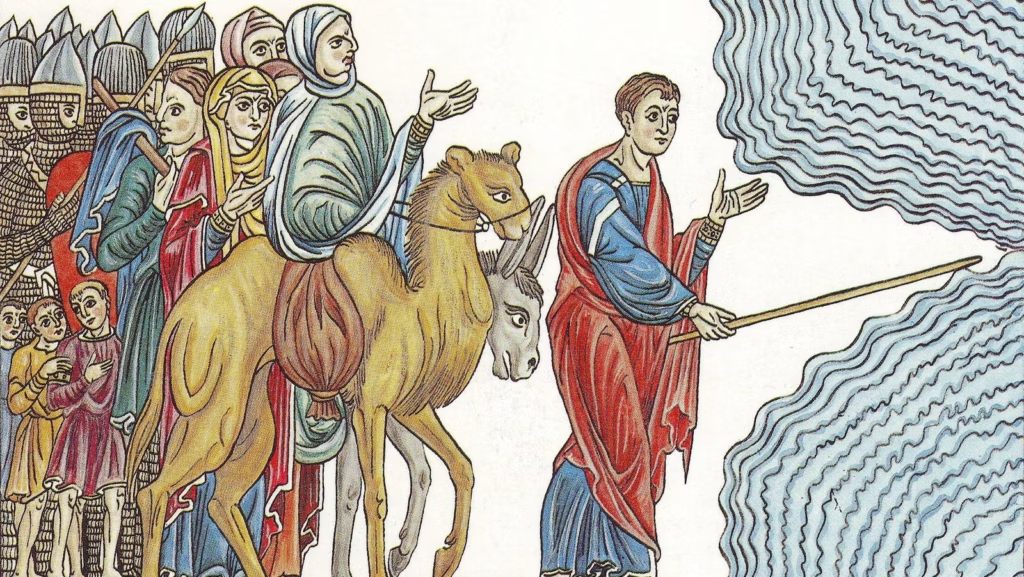
“Moses at the Red Sea” by Herrad of Landsberg circa 1180. (Wikimedia)