
Erev Shabbat Bamidbar – 30 May 2025 / 4 Sivan 5785
Parashat Bemidbar, the opening portion of the Book of Numbers, sets the stage for the Israelites’ journey through the wilderness, a period of formation, transformation, and divine encounter. Read before Shavuot, it invites reflection on the role of the desert (midbar) in shaping identity. The word midbar in Hebrew has the same root as the word davar, word, or thing. It is in the wilderness of Sinai that our ancestors were able to hear God’s words (vayedabber Adonai) when they were deprived of most of their possessions, their “things”.
In this parasha, the tribes are named; they are given specific roles, not only for their wandering in the wilderness but also for later, when they reach the promised land and settle in it. The fact that we read these texts right before Shavuot is a way for the people to say, Hineini, here I am, ready to hear your words (devarim), ready to understand my missions.
Tonight, I would like to reflect aloud with you on this notion of desert. Anyone who has spent at least a few hours in a desert will remember the deafening silence, the sheer heat and the sensation of being cut from the world, left alone with oneself. It can be scary, but also a necessary withdrawal into the self, to discover who or what we are.
The midbar in Parashat Bemidbar is not a barren landscape; it’s a place of discomfort where the Israelites are counted, organised, and assigned roles. The census (Numbers 1:1-46) records each person by name, affirming individual worth, while the tribal encampments (Numbers 2) and the Levites’ duties (Numbers 3-4) create a structured community around the Tabernacle. Each tribe has a specific place—Judah in the east, Reuben in the south, and so on—and the Levites undertake tasks from carrying the Tabernacle’s components to guarding its sanctity. This diversity of roles reflects a profound truth: a community thrives when each person contributes their unique purpose, yet all are united by a shared centre—the Divine presence.
The desert’s vastness contrasts with this order, highlighting the need for structure in the midst of chaos. Each role, whether leading a tribe or dismantling and transporting the Tabernacle, is essential, teaching us that no contribution is too small. The desert setting reminds us that purpose can emerge even in seemingly empty spaces, provided we embrace our responsibilities within a collective.
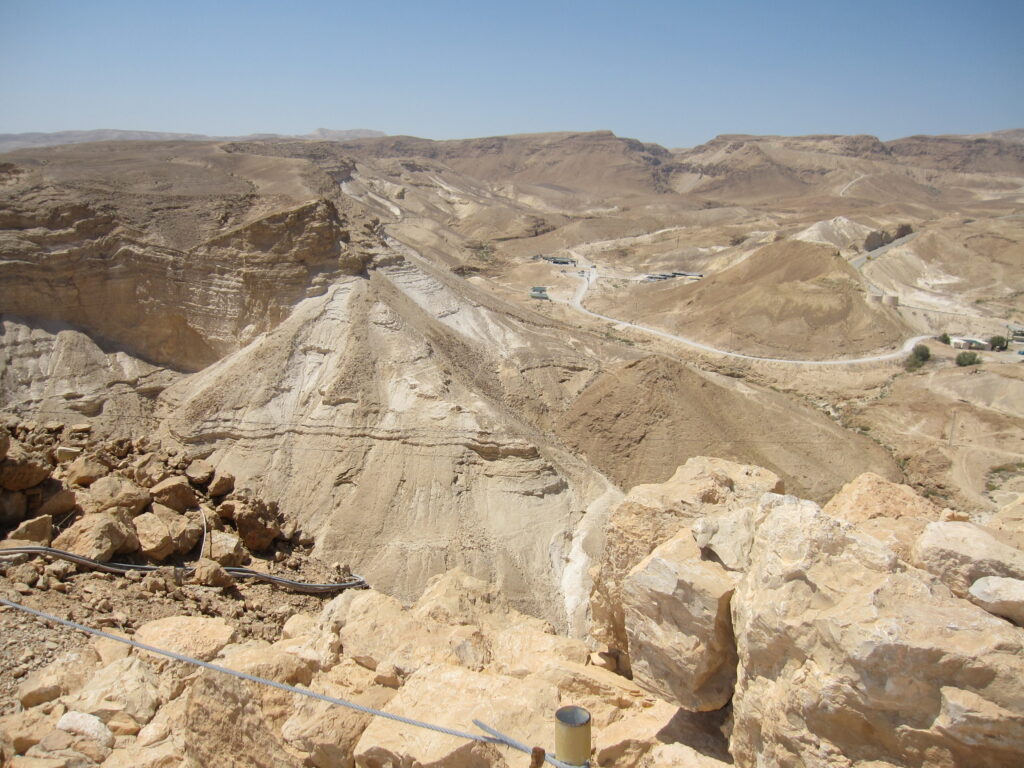
Desert at Massada
As you know, Hebrew is written only with consonants. It is only in the Middle Ages that a group of grammarians, called the Masoretes, added vowels to ensure that the text was properly read. Most of the time, it is of no consequence, but in this particular instance, the Masoretes vocalised the consonants B.M.D.B.R. bEmidbar, “in a desert”, with the indefinite article, and not bAmidbar, “in the desert.” For them, who were also interpreters of our texts, the desert wasn’t just a physical space; there was something more.
The wilderness becomes not just the Sinai Desert but a metaphor for any liminal space—physical, emotional, or spiritual—where identity and purpose are forged. The Israelites’ journey is not confined to one particular desert; it represents all moments of transition, uncertainty, or spiritual seeking. Bemidbar suggests immersion in this state, as if the Torah is saying, This story is about dwelling within the wilderness experience, wherever and whenever it occurs.
Theologically, Bemidbar implies openness and humility. A specific wilderness (Bamidbar) might suggest a known, bounded place with clear landmarks and locations. But “a wilderness” is undefined, vast, and humbling, stripping away assumptions and forcing reliance on God. Commentators like Rashi note that the Torah’s language often carries symbolic weight, and here, Bemidbar may describe the desert as a place of divine encounter, free from the distractions of civilisation. The Israelites receive the Torah in this open, unformed space, suggesting that God’s presence is most accessible when we let go of control and embrace the unknown.
The choice of Bemidbar also has implications for our relationship with God and community. “In a wilderness” suggests that divine guidance is not limited to one place or time but is available in any moment of vulnerability or transition. It invites us to see our own “wildernesses”—times of doubt, change, or loss—as opportunities for growth and connection with the Divine. By contrast, Bamidbar might tether the narrative to a historical moment, limiting its universal resonance. The indefinite Bemidbar thus broadens the parasha’s message, making it a timeless call to find God and purpose in any wilderness.
The desert is a powerful metaphor for times of transition, challenge, or renewal. Just as the Israelites needed the wilderness to transition from slavery to nationhood, we sometimes need “desert” moments—periods of solitude, uncertainty, or simplicity—to grow. The desert strips away excess, forcing us to confront our existence and our choices. It’s where we ask, Who am I? What matters? What is my role? For the Israelites, the desert was a barren space for receiving the Torah, suggesting that clarity often emerges in sparse, empty spaces.
Parashat Bemidbar invites us to embrace the desert as both challenge and opportunity. Its call to count each person, assign roles, and dwell in a wilderness (Bemidbar) reminds us that growth often happens in sparse, uncertain spaces. We need the desert to strip away noise, to discover our unique contributions, and to reconnect with what’s sacred. Yet, we must guard against its loneliness by seeking community and purpose, as the Israelites did around the Tabernacle. In today’s noisy, fragmented world, Bemidbar’s lessons—structure, unity, and clarity—guide us to navigate global challenges with intention and faith, transforming our urban deserts, or the wilderness of our hearts, into spaces of meaning, renewal, and encounter.
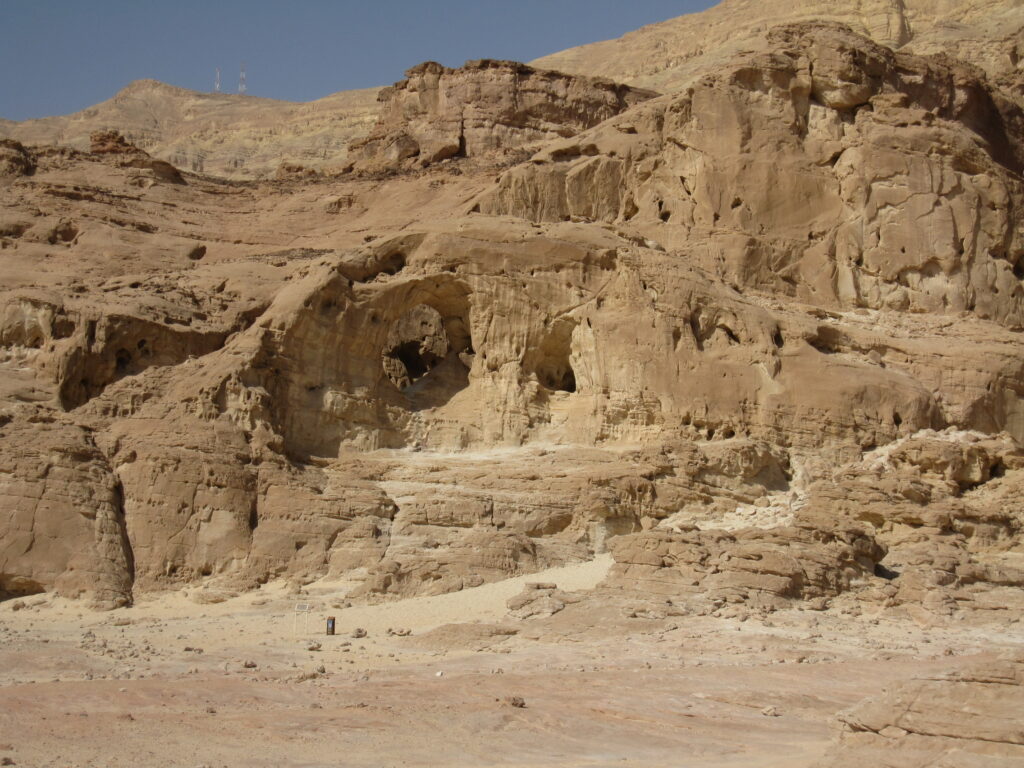
Desert in the Negev.