Parashat Acharei Mot – Kedoshim – 10 May 2025 / 12 Iyyar 5785
“God spoke to Moses after the death (acharei mot) of the sons of Aaron…” (Lev. 16:1). Our weekly Torah portion begins with these words, “after the death of.” There is a life after death, an occasion to rebuild something different, perhaps better. God explains to Moses how to make proper atonement in the Tent of Meeting—not like what the sons of Aaron did, which was messy and disorganized, but in a way that ensures the process is effective and transformative.
Today, we could tell another story: Acharei Mot, after the death of 60 million people between 1939 and 1945—including 6 million Jews—a new world order emerged, more organized, meant to ensure that such a catastrophe would never happen again.
Yet 80 years after the end of this war, the very notion of “never again” might provoke a bitter smile, were the current situation not so deeply troubling.
Where do we stand, 80 years after the end of the largest, deadliest war that humankind has waged against itself?
We honor the lives of those who sacrificed themselves to defeat fascism and oppression. The history of the war is well-documented and need not be retold here. It suffices to remember that while the tide turned against Germany as early as 1942, it took three harrowing years to finally defeat Nazism. This was a total war—all or nothing—a war of complete destruction, especially on the Eastern Front, where the Nazis believed the Slavic peoples were their racial enemies who should, at best, be enslaved.
On the 8th of May, we also remember that this was a war against extremism, and we are reminded how quickly societies can descend into division and hatred. Eight decades later, one may wonder: have we learned the lessons? We see barriers being erected and ethnic and social prejudices once again deemed acceptable. The political landscape of Western democracies is shifting toward right-wing populism, not dissimilar to the patterns of the 1930s.

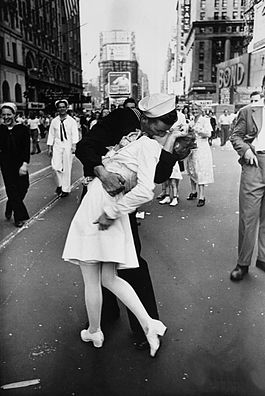
Article published on the BBC website on May 8th, 2025: “Trouble just fell from our shoulders.”
But VE Day also contains a lesson of hope. We remember when nations overcame their differences for a greater cause—to defeat a greater evil. Human beings possess this innate capacity to collaborate when facing major threats and to envision a better world. Yet today, celebrations in Moscow and in Western capitals differ profoundly in tone and content. Putin uses the 9th of May celebrations to justify his war against Ukraine as a battle against supposed modern-day Nazism, undeterred by the fact that Ukraine’s president is Jewish and his family suffered during the Holocaust.
However flawed and imperfect the world order that emerged from the ashes of war, it has prevented major worldwide conflagrations. But this hasn’t meant the end of tensions and conflicts. Today, the war in Ukraine continues—the first war on European soil since 1945—while the entire Middle East is destabilized by the ongoing conflict between Israel and Hamas, and now India and Pakistan have taken up arms against each other. Germany has marked the 80th anniversary without inviting Russia and Belarus, while Russia commemorates this day by inviting China and excluding Western countries. Though the future remains uncertain, we all understand the devastating consequences should another world war erupt. Perhaps this shared understanding is what will prevent it.
But, as the Torah teaches, Acharei Mot—after death—we can rebuild a better world. In the same passage, the Torah enjoins us: “kedoshim tiyhu“—be holy because I, the Eternal, am holy.
The primary meaning of the root K.D.Sh centres on separation, distinction, and consecration. Yet this separation has a specific, sacred purpose—not difference for its own sake. Our time and actions become sacred when they transform the world around us.
In our Torah portion, we find commandments such as, “You shall not take vengeance or bear a grudge. Love your neighbour as yourself” (Lev. 19:18), and “you shall not stand idly by the blood of your neighbour” (Lev. 19:16). Holiness is achieved neither through ritual alone nor through separation from the world’s troubles.
True holiness emerges precisely in how we respond to the world’s brokenness—through justice, compassion, and the refusal to turn away from suffering. The wartime generation understood this intuitively. Their holiness manifested in the patient, difficult work of reconstruction—not just of buildings, but of human relationships and international cooperation.
And today, amid ongoing conflicts and bloodshed, where do we find holiness? Perhaps we need to remember that holiness is not the absence of death or conflict. It is the constant choice to see the divine image in others, even—perhaps especially—in times of division and hatred. “Be holy” is not a statement about who we are, but who we should become: after death, conflict, and trauma, we are called to repair the brokenness around us.
We cannot avoid conflict. Conflicts seem intrinsic to how we, as imperfect human beings, settle our differences. But we can decide what to do with conflict—how to resolve it in a proper, menschlich, holy way.
May the memory of the wartime generation inspire our holy mission to repair our broken world. Never in the past 80 years has this imperative been so urgent. But we can help fix the world and build a loving, caring society. That is our sacred calling today.
Ken Yehi Ratzon, may it be God’s Will.
VE Day in Time Square photo by Alred Eisensteadt.