Judaism, at its heart, has always been progressive. From the Israelites of the Iron Age to the Progressive Jews of 21st-century Britain, we’re bound not by a bloodline but by what Amos Oz and Fania Oz-Salzberger beautifully called a “text line.” This thread of interpretation stretches across millennia, tying us to our ancestors even as the outer forms of our tradition shift and adapt. It’s a living conversation, one that invites each generation to add its voice.
Consider a story from the Talmud, in Bava Metzia 59b, where the sages debate the ritual purity of an oven made of clay tiles held together with sand. Is it a single vessel, or just a collection of pieces? Can we use it without fear of impurity? At first glance, this might seem like a trivial concern—much like modern debates over whether glass can be koshered for Passover with boiling water or if we should simply buy new glassware for the festival’s stringency. But these questions, as the Talmud often shows, are doorways to deeper truths. The sages’ deliberations on practical matters lead to profound legal and symbolic insights, revealing the dynamic nature of Jewish law.
In this particular debate, Rabbi Eliezer stood alone, declaring the oven pure. His colleagues disagreed, but Eliezer wasn’t one to back down easily. “If I’m right,” he proclaimed, “let this tree prove it.” At once, a nearby tree uprooted itself and replanted hundreds of metres away. The other sages, unimpressed, retorted, “What can a tree prove?” Undeterred, Eliezer continued, “If I’m right, let this river confirm it.” The river reversed its flow, streaming uphill. Still, his colleagues dismissed the miracle. Eliezer pressed on: “If I’m right, let the walls of this study house bend in my favour.” The walls trembled, leaning toward the sages as if to crush them, but the rabbis scolded them, saying, “This debate is none of your business!” The walls froze mid-collapse.
As a final plea, Eliezer called on the heavens: “If I’m right, let a celestial voice declare it.” A Bat Kol, a divine voice, resounded, affirming, “The view of Rabbi Eliezer is in accordance with the Law.” At that moment, Rabbi Joshua rose and delivered a line that echoes through Jewish thought: “The Torah is not in the heavens.” Quoting Deuteronomy 30:11-14, he reminded everyone that the Torah, given at Sinai, now belongs to us: “It is not in the heavens… nor beyond the sea… No, the thing is very close to you, in your mouth and in your heart, to observe it.” Joshua boldly told the Divine, “You gave us the Law, and now its interpretation is ours. No miracle, no supernatural sign, can override the majority’s wisdom.”
The Talmud concludes with a startling image: the Divine, laughing, says, “My children have defeated me; my children have defeated me.” This isn’t a moment of defeat but of celebration—a divine acknowledgement that Torah lives through human engagement. As Rashi notes on this verse, the Torah isn’t hidden; it’s been given to us in written and oral forms, and it’s our sacred duty to study, debate, and interpret it for our time. To develop the Law isn’t a betrayal of the past—it’s a celebration of the tradition’s genius, ensuring its words remain alive and meaningful.
The Adaptability of Tradition
The Torah’s wisdom is “very near to you, in your mouth and in your heart” (Deuteronomy 30:14)—a call to ongoing interpretation rather than rigid repetition of ideas that have calcified into slogans. Take the story of Zelophehad’s daughters in Numbers 27:1-7. These five women—Mahlah, Noah, Hoglah, Milcah, and Tirzah—approached Moses with a plea: their father had died without sons, leaving his inheritance at risk. They asked for a share among their father’s kin, and Moses brought their case before the Eternal. The Divine responded, “Their plea is just: give them a hereditary holding.” This wasn’t a change in divine will but a permission to expand the law for a new situation—a powerful example of Torah’s adaptability.
The Talmud reinforces this in Menachot 29b, where Rabbi Yannai teaches that the Torah wasn’t given as clear-cut rulings. For every statement, the Divine offered Moses forty-nine arguments for impurity and forty-nine for purity, leaving interpretation to us. When ancient texts clash with modern ethics, we’re empowered to read, reflect, and sometimes set aside what no longer aligns with our values. Such abandonment isn’t betrayal or irreverence; it’s true reverence, balancing tradition with the reality of a world that’s moved on. As Megillah 21b notes, some matters are “hidden from the eyes” until a sage like Rabbi Shimon ben Lakish—Reish Lakish—comes to unlock new understanding.
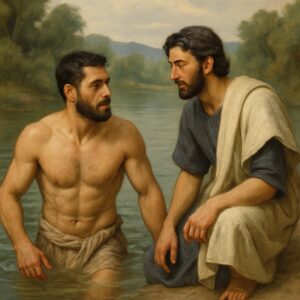
Reish Lakish’s own story, preserved in the Talmud, speaks to this diversity of perspective. A 3rd-century sage from Sepphoris, he was once a gladiator and bandit, fallen on hard times (Gittin 46b), until Rabbi Yochanan encountered him bathing in the Jordan (Berakhot 31a) and drew him into a life of Torah. Having lived on the margins, Reish Lakish understood the world from its edges, not its centre. His life reminds us there’s no single way to approach Torah—it meets us where we are.
This multiplicity is echoed in Shemot Rabbah 5:9, where Rabbi Yochanan teaches that at Sinai, the Divine voice split into seventy languages, ensuring every nation could hear it in their tongue. Similarly, Pesikta de-Rav Kahana 12 (as translated by The Velveteen Rabbi) reflects on the Divine’s varied appearances: a mighty warrior at the Red Sea, a teacher at Sinai, an elder in Daniel’s time, and a young figure in Solomon’s era. Rabbi Hiyya bar Abba adds that the Divine appeared “in a guise appropriate to each and every place and time”, ensuring the message resonated with each generation’s spirit. At Sinai, as a teacher, the Divine stood in awe, mirroring the reverence of Torah study—a reminder that divine presence adapts to our needs while remaining one: “I am Adonai your God” (Exodus 20:2).
The Small Aleph of Humility

Torah isn’t a monolith, nor was it meant to be a “correct opinion” (the root of orthodoxy). Even the greatest theologian can’t claim to grasp the Divine fully will—a lesson etched into the very text of Leviticus 1:1, where the word vayikra (“and [God] called”) begins with a tiny aleph: “וַיִּקְרָא אֶל־מֹשֶׁה.” The Midrash (Tanchuma, Vayikra 1) explains that Moses, in his humility, wanted to write vayiker (“and [God] happened upon”), suggesting a chance encounter rather than a special calling. The Divine insisted on vayikra but allowed the aleph to be small, a nod to Moses’ modesty. This tiny letter teaches us that true learning requires humility. If we think we know it all, there’s no room for growth. The small aleph whispers that the sacred isn’t always clear—it asks us to approach with openness, ready to see the Divine in unexpected ways.
Conclusion: Revelation as a Progressive theological Journey
Revelation, like Creation, is an ongoing process, not a single moment frozen in time. As Rabbi Isaac Mayer Wise wrote in 1871, “Change, universal and perpetual, is the law of laws… Judaism, from this standpoint, admits no retrogression and maintains that all forms… were necessarily beneficial for each respective time and locality.” Drawing on Hermann Cohen’s philosophy, progressive revelation began at Sinai and continues today, evolving as we engage with Torah across generations.
As Progressive Jews, we hold the freedom—and the responsibility—to interpret our tradition anew. Claude Montefiore captured this sentiment in 1923: “Only Liberal Judaism possesses liberty—conscious, reasoned, and deliberate… to examine its house reverently, tenderly, lovingly, but freely.” We stand on the shoulders of our ancestors, not to repeat their words, but to carry their spirit forward, ensuring Judaism remains a living, breathing tradition for all time.