
In my synagogue, we held today a Seder for children. I found the retelling of the Exodus to young children very moving, and listening to it through their little eyes and ears was a refreshing experience. We’ve heard it so many times, and yet, each time, it is new. Each time, we learn something about our past and about ourselves. We become the stories we tell.
The central mitzvah of the Seder is not the matzah, the bitter herbs, or even the festive meal, but rather “v’higadta l’vincha” — “and you shall tell your child” (Exodus 13:8). We are commanded to narrate our journey from slavery to freedom, to make it personal, immediate, and alive.
The Haggadah instructs: “In every generation, each person must see themselves as if they personally had come out of Egypt.” This instruction is not merely poetic language but a profound psychological and spiritual directive. When we tell the Exodus story as our own, we are not simply recounting ancient history—we are making ours a story that our ancestors heard as well.
Through the centuries, as our people faced persecution, expulsion, and genocide, the Pesach narrative provided continuity and hope. As we gathered around Seder tables in mediaeval Spain, in the shtetls of Eastern Europe, in concentration camps, in the Soviet Union, and in modern Israel and diaspora communities, we have affirmed: “We were slaves to Pharaoh in Egypt, and the Eternal our God brought us out with a mighty hand and an outstretched arm.”
This storytelling transforms us. Research in psychology affirms what our tradition has long understood: narrative is essential to identity formation. The stories we internalise shape how we see ourselves, how we interpret events, and how we imagine future possibilities.
Of course, each generation heard it in their context. I’ve always wondered how the Jews in the Warsaw ghetto in 1943 felt when the Nazis entered the ghetto to crush their uprising. They surely knew that for most of them, this would be the last Seder, and yet, they celebrated it to keep the flame alive in the hope that future generations will be able to celebrate it again.
This year, as the war continues in Israel and Palestine, as many hostages are still held in captivity and won’t be at the Seder table, and as Gaza is completely flattened and ruined, it becomes obvious, compelling, and imperative to understand that we will be free only when everyone else is. The essence of Pesach, the messianic times, when all will be free, is a nagging, obliging reminder that we must all work towards complete liberation. There is no freedom if part of humankind is in shackles.
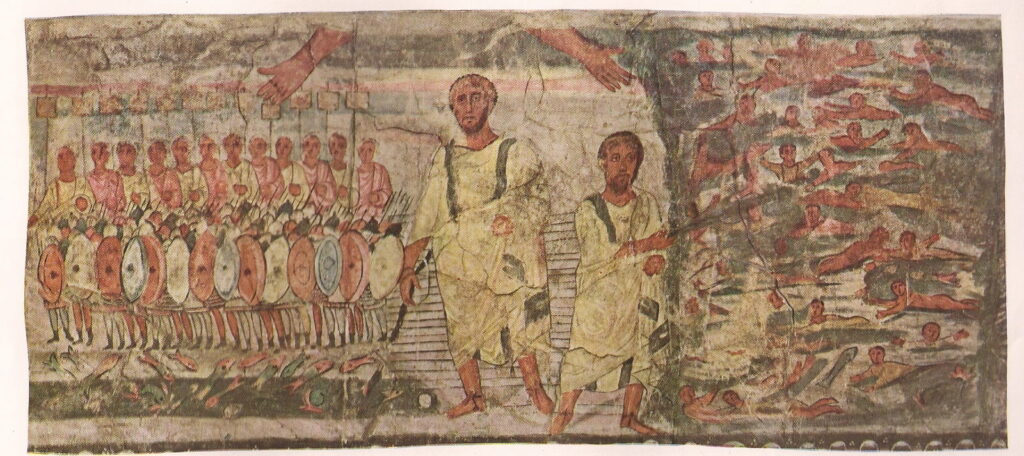
Moses splitting the sea – Dura Europos synagogue

The message of Pesach, while deeply rooted in Jewish experience, transcends particular communities. It is universal. Its narrative of liberation has inspired countless movements for freedom and justice throughout history.
Broken down into principles, the essence of Pesach is:
Oppression is never definitive. No matter how entrenched systems of domination appear, change is possible.
Liberation requires both divine intervention and human partnership. God worked through Moses and the people; the journey required both miracle and human courage.
Freedom is a process, not an event. Leaving Egypt was just the beginning of a longer journey toward the promised land.
To cultivate empathy, we remember our suffering. The Torah repeatedly commands us to care for the stranger “because you were strangers in the land of Egypt”.
As Martin Luther King Jr. and so many others recognised, the Exodus narrative provides a powerful template for understanding the human journey from oppression to freedom. It teaches us that tyranny—whether political, economic, or spiritual—can and must be overcome.
In our complex and divided world, the Pesach story remains urgently relevant. Today, we might ask ourselves:
- How are we still enslaved—to consumerism, to cynicism, to prejudice, to fear?
- Where do we need liberation in our personal and communal lives?
- How might the Exodus inspire us to stand in solidarity with those still struggling for freedom?
- What responsibility do we bear, as those who celebrate liberation, toward others who remain oppressed?
Our Seder tables should be places not just of commemoration but of genuine questioning and commitment to the work that remains undone. The Haggadah begins with an invitation—”Let all who are hungry come and eat”—reminding us that our celebration is incomplete while others suffer. We do more than recall ancient events. We actively shape who we are and who we might become. We join a conversation that has continued for millennia and will continue long after us. We affirm that freedom is both gift and responsibility, and a gift given to all human beings.
May this Pesach season bring renewed commitment to the work of liberation—in our lives and throughout our world.
Chag Sameach.

