
Parashat Ki Tissa
15 March 2025 / 15 Adar 5785
In this week’s parasha, Ki Tissa, we meet Betzalel, the master craftsman chosen by God to oversee the construction of the Tabernacle (Mishkan)—the sacred space where God’s presence would dwell among the Israelites. This moment is a pivotal part of the desert narrative, highlighting the intersection of the divine and the human. The individual tasked with translating God’s vision into physical form must possess extraordinary qualities.
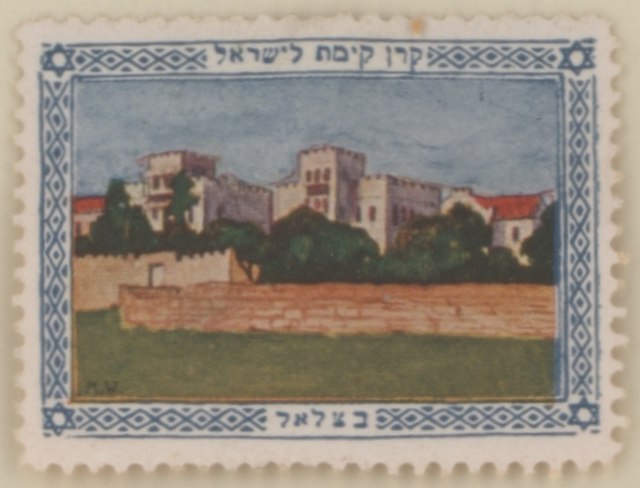
JNF stamps and labels.
The Torah states:
“See, I have singled out by name Bezalel son of Uri son of Hur, of the tribe of Judah. I have endowed him with a divine spirit of skill, ability, and knowledge in every kind of craft.”
(Exodus 31:2–3)
רְאֵה קָרָאתִי בְשֵׁם בְּצַלְאֵל בֶּן־אוּרִי בֶן־חוּר לְמַטֵּה יְהוּדָה: וָאֲמַלֵּא אֹתוֹ רוּחַ אֱלֹהִים בְּחָכְמָה וּבִתְבוּנָה וּבְדַעַת וּבְכָל־מְלָאכָה
Betzalel is described as a man gifted with wisdom, understanding, and knowledge—attributes that uniquely qualified him for this holy task. Together, these qualities enabled him to achieve something remarkable. Let’s explore each one in turn.
Chochmah: Wisdom
The first quality, chochmah (wisdom), reflects Betzalel’s ability to grasp and execute complex designs. Constructing the Mishkan required intricate craftsmanship, and his wisdom allowed him to transform divine instructions into a tangible reality.
In our lives today, we face challenges that demand creativity, practical skills, and intellectual clarity. Our world is complex and often difficult to navigate, yet chochmah equips us to solve problems and create meaningful solutions. Just as Betzalel used his wisdom to build a sanctuary for God, we are called to apply our talents to craft spaces—whether physical, emotional, or communal—that reflect purpose and holiness. His example shows that wisdom is not merely theoretical; it’s a practical tool for building a better world through our professions, art, or service to others.
Tevunah: Understanding
The second quality, tevunah (understanding), goes beyond knowing what to do—it’s about knowing how to do it effectively. Betzalel’s deep insight into materials and processes enabled him to integrate the Mishkan’s many elements into a cohesive whole. He wasn’t just a skilled artisan; he had an intuitive sense of how to use resources wisely and bring the vision to life.
For us, tevunah encourages thoughtful planning and reflection. In a fast-changing, uncertain world, it’s tempting to act impulsively, but Betzalel teaches us to pause, consider the broader implications, and approach challenges with care. Whether in relationships, work, or community involvement, this quality enables us to see beyond the surface and approach situations with foresight and depth.
Da’at: Knowledge
The third quality, da’at (knowledge), refers to an intimate, detailed mastery of a subject. For Betzalel, this meant not only technical expertise but also a profound awareness of the Mishkan’s sacred purpose. His knowledge infused every detail with spiritual significance, elevating the structure beyond mere craftsmanship into a vessel of holiness.
In our modern context, da’at inspires us to combine expertise with purpose. While knowledge is more accessible than ever, it can often feel shallow or disconnected from meaning. Betzalel reminds us that true knowledge involves understanding the “why” behind our actions. Whether we’re learning, working, or engaging with the world, we should strive to align our skills with a greater sense of purpose, benefiting both ourselves and others.

Reconstitution of the Tabernacle.
A Modern Application
Today’s fast-paced, fragmented world can feel overwhelming, but Betzalel’s qualities offer a timeless guide for living with intention. By cultivating chochmah (wisdom), tevunah (understanding), and da’at (knowledge), we can address modern challenges in ways that are both practical and spiritually meaningful.
Here’s what we can learn:
- Wisdom empowers us to make thoughtful decisions and use our skills for the greater good.
- Understanding calls us to approach problems with care, seeking deeper insight and foresight.
- Knowledge reminds us that expertise is most valuable when connected to a larger, meaningful purpose.
Betzalel’s example inspires us to build more than just physical structures. Through these qualities, we can create strong relationships, vibrant communities, and a world that reflects holiness, harmony, and purpose.