In the annals of biblical history, the two bronze pillars of the First Temple in Jerusalem—named Jachin and Boaz—stand as enduring symbols of strength and sanctity. As recorded in Jeremiah 52:17, “The Chaldeans broke up the bronze columns of the House of the Eternal, the stands, and the bronze tank that was in the House of the Eternal, and they carried all the bronze away to Babylon.” This destruction marked the end of an era, but the legacy of these pillars would echo far beyond their physical ruin.
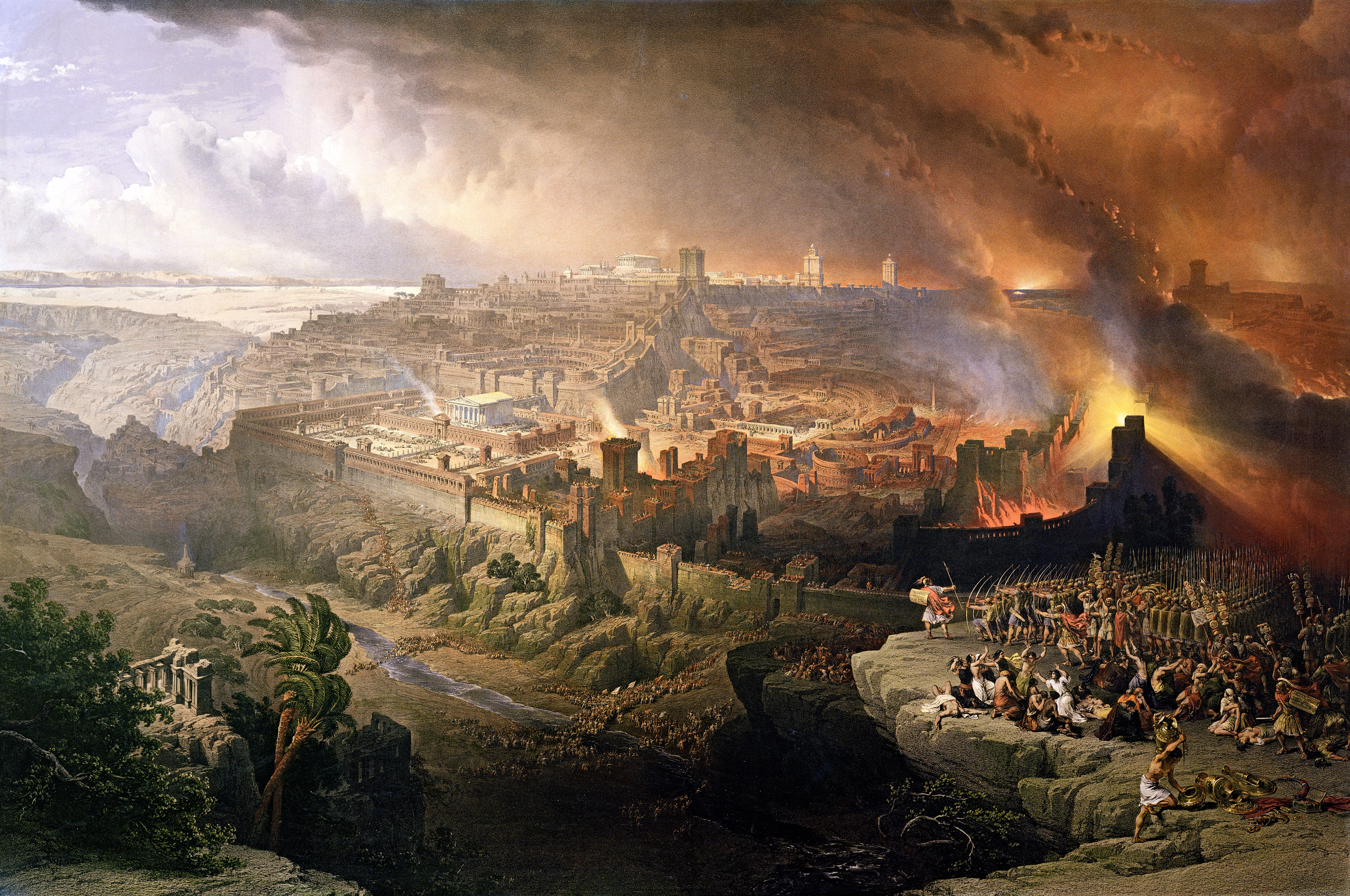
The story begins with King Jehoiachin of Judah, who rebelled against Babylonian rule in 597 BCE. King Nebuchadnezzar responded decisively, besieging Jerusalem, capturing the city, and exiling much of its population to Babylon. Jehoiachin’s uncle, Mattaniah—renamed Zedekiah—was installed as a puppet king. Yet, eleven years later, Zedekiah too defied Babylon. The reprisal was merciless: after a gruelling siege of 18 to 30 months, Jerusalem fell in 586 BCE. The Chaldeans “burnt the House of the Eternal, the king’s house, and all the houses of Jerusalem” (2 Kings 25:9), leaving only the poorest behind as labourers. This calamity, rivalled only by the Temple’s second destruction in 70 CE, shattered Judean society. Under Persian rule from 539 BCE, the exiles returned and constructed a second temple, completed in 516/5 BCE—but it was a shadow of its predecessor.
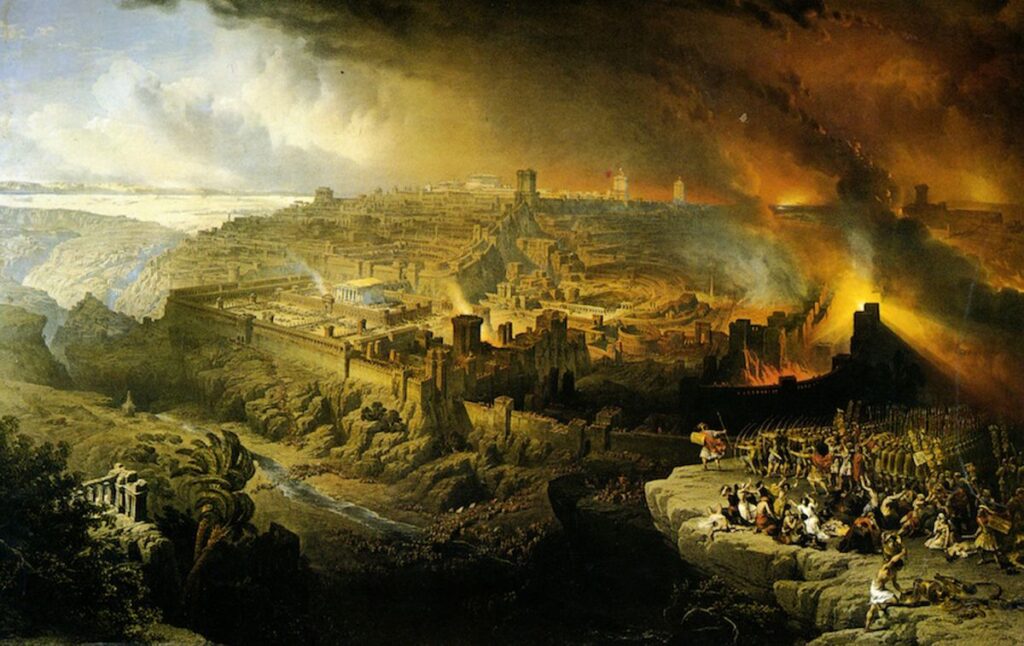
The Siege and Destruction of Jerusalem, David Roberts, 1850
The First Temple, built by King Solomon and completed in 957 BCE according to Hebrew Scriptures, was a marvel designed to house the Ark of the Covenant. This sacred chest, which had journeyed with the Israelites through the desert and conquest, found a permanent home, replacing the portable Tabernacle, or “Tent of Meeting”. Yet, the Second Temple lacked this centrepiece: the Ark, along with the Tablets of the Covenant, vanished after 586 BCE, its fate a mystery. In its place, the Holy of Holies stood empty, veiled by thick curtains, accessible only to the High Priest once yearly to utter God’s hidden name. The two pillars, Jachin and Boaz, shattered by the Chaldeans, were not restored.
These pillars, first described in 1 Kings 7:21 and 2 Chronicles 3:17, flanked the Temple’s vestibule. Hiram of Tyre, Solomon’s master craftsman, erected them, naming the right pillar Jachin (“He shall establish”) and the left Boaz (“In strength”). Their symbolic weight outshone their architectural role—they stood free, supporting no roof, yet marking the threshold between the profane and the sacred. Early Christians and Rabbinic Jews knew only the Second Temple, yet their writings fixated on Solomon’s original, its blueprint etched in collective memory. Freemasonry, too, embraced this vision, elevating Jachin and Boaz to central icons.
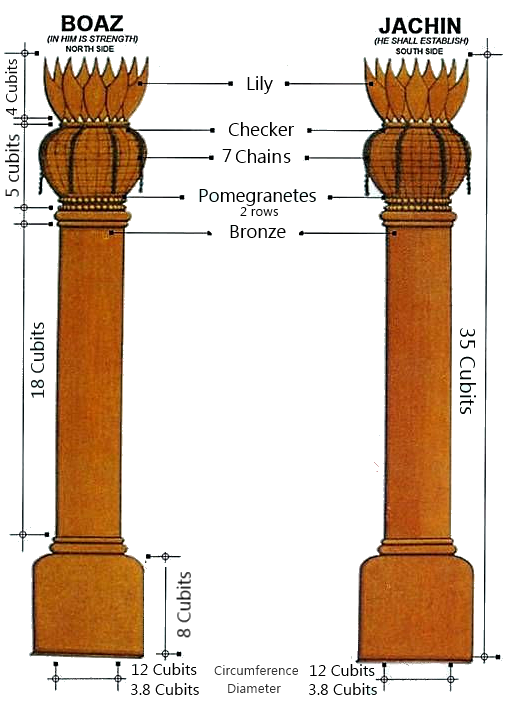
Columns Boaz and Jakin.
Cosmic Symbolism and Masonic Legacy
The Midrash Tadshe, a pseudepigraphic text tied to the second-century sage Pinchas ben Ya’ir, offers a cosmic lens: Jachin aligns with the moon, tied to Psalm 89:38 (“David’s throne shall be established forever as the moon”), guiding Israel’s festivals (Psalm 104:19). Boaz embodies the sun, radiant and strong, as in Psalm 19:6 (“He rejoices like a strong man to run his course”). Positioned at the Temple’s entrance, they symbolized the stability and might of the Davidic line. Freemasonry, however, reimagined them literally—Boaz as the ancestor of Solomon through his son Obed, and Jachin as a minor figure from Genesis 46:10—yet the Midrashic link to sun and moon persists, subtly threading Jewish tradition into Masonic ritual.
Why did these pillars grace Solomon’s Temple but vanish from the Second? Scholars like Rabbi Raymond Apple suggest they echoed Egyptian pylons—massive gate structures symbolizing the sun’s daily arc between two hills, often paired with obelisks honoring Ra. The Temple’s east-west axis mirrored this solar path, and Hiram, hailing from Tyre, likely drew on Egypt’s architectural grandeur. By 516 BCE, with Egyptian influence waning, the Second Temple’s builders omitted them, deeming them extraneous. Yet Freemasonry revived their mystique, weaving Egyptian echoes into its Craft.
The Pillars in Freemasonry
In Masonic lore, the Temple of Solomon reigns supreme. The Second Temple appears only in higher degrees—like the 15th of the Scottish Rite or the York Rite’s Holy Royal Arch—while Jachin and Boaz anchor the first and second degrees as sacred words. Their placement sparks debate: biblical texts position Jachin to the right and Boaz to the left, but from whose perspective? Mishnah Sukkah 5:4 describes worshippers ascending to the Temple, turning west at the eastern gate to avoid sun-worship suspicions, suggesting Jachin lay south and Boaz north. The Scottish Rite adopts this view from the master’s westward gaze, while the French Rite reverses them, emphasising the entrant’s journey. Neither is “correct”—it’s a matter of vantage point. Ultimately, Jachin and Boaz frame the Lodge’s entrance, a threshold between the mundane and the divine. Their names affirm Freemasonry’s foundation: stability and strength. To cross this boundary is to step into a higher realm, where movement is ritualised, and the sacred unfolds.
Ultimately, Jachin and Boaz frame the Lodge’s entrance, a threshold between the mundane and the divine. Their names affirm Freemasonry’s foundation: stability and strength. To cross this boundary is to step into a higher realm, where movement is ritualised, and the sacred unfolds.
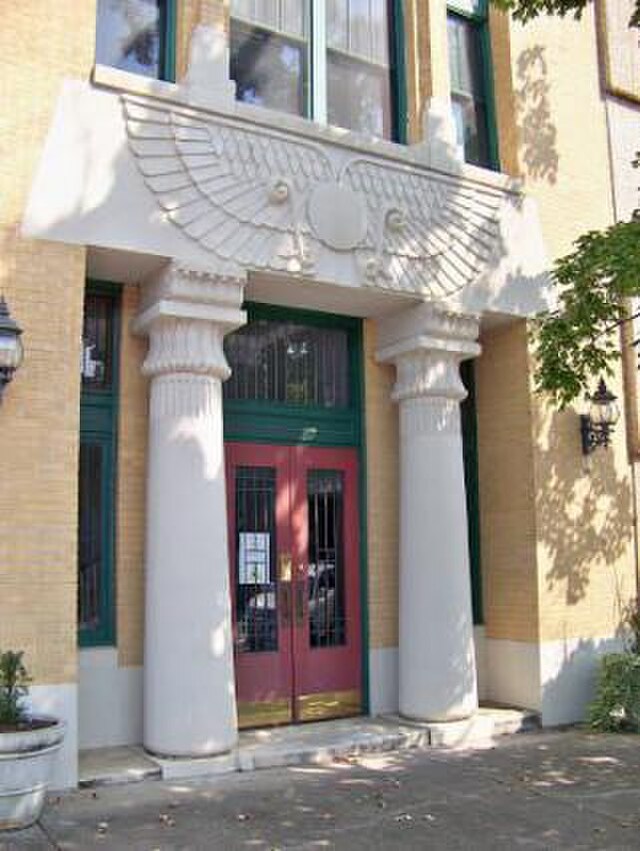
Masonic Temple, Shelby, North Carolina