
As the sun dips below the horizon, Jacob pauses at “a certain place,” takes a stone for a pillow, and settles into sleep. What follows is one of the Bible’s most vivid dreams:
“He had a dream: a stairway, or a ladder, was set on the ground, and its top reached the sky. Angels of God were going up and down on it. The Eternal stood beside him, saying, ‘I am the Eternal, the God of your father Abraham and the God of Isaac. The ground you are lying on I will assign to you and your offspring… Remember, I am with you. I will protect you wherever you go, and I will bring you back to this land. I will not leave you until I have done what I have promised you.’ Jacob awoke and said, ‘The Eternal is surely in this place, and I did not know it! … How awesome is this place! This is none other than the abode of God, and that is the gateway to Heaven.'”
(Genesis 28:10-13; 15-17)
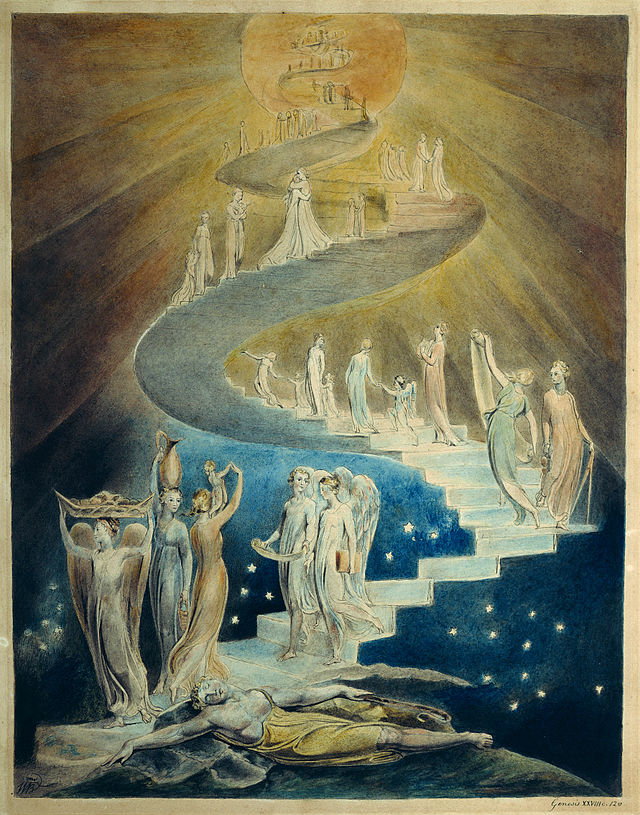
Jacob’s Ladder, William Blake, 1800

This moment marks a turning point for Jacob, a fugitive wrestling with guilt and uncertainty. Yet, in his vulnerability, he encounters the divine—a ladder bridging earth and sky, a promise of protection, and a revelation that transforms a nameless “place” into sacred ground.
A Sacred Place in Biblical Tradition
Where exactly was Jacob when this vision unfolded? The text calls it simply “the place,” but Jewish tradition offers a compelling answer. The medieval scholar Rashi identifies it as Mount Moriah, the future site of the Temple in Jerusalem—a location already steeped in divine encounters, like the binding of Isaac generations earlier. The Targum Jonathan, an ancient Aramaic translation, deepens this connection: “And he—Jacob—prayed in the place of the Holy Temple and slept there because the sun had set.” In the sacred geography of the Bible, Mount Moriah is a cosmic axis, a thin place where the veil between worlds lifts, revealing the presence of God.
Centuries later, after the Temple’s destruction in 70 CE, the Rabbis turned to this story to reimagine Jewish practice. In the Babylonian Talmud (Tractate Berakhot, 26b), they declare: “Jacob instituted the evening prayer, as it said, ‘and he encountered the place, and he slept there.’ Encounter means nothing but prayer.” For them, Jacob’s ladder became more than a dream—it was a model of spiritual ascent, a dialogue between humanity and the divine.
The Hebrew word for ladder, sulam, appears only here in the entire Bible, a unique term rich with meaning. Its numerical value in gematria (130) aligns with Sinai—the mountain of revelation—and Kol, meaning “voice.” Picture this: the ladder springs from Jacob’s resting body, its base rooted in the earth, its summit piercing the heavens. Angels ascend first, carrying prayers upward, then descend, bringing divine response. It’s a dynamic image of the soul’s journey—a movement from the mundane to the eternal, opened only by human effort.
At the dream’s peak, God speaks, renewing the covenant made with Abraham and Isaac: a land for Jacob’s descendants, a promise of presence and protection. These words answer unspoken fears, lifting Jacob from despair to awe. Upon waking, he exclaims, “The Eternal is surely in this place, and I didn’t know it. This is the abode of God.” Here, transcendence and immanence collide—a fleeting moment when two worlds touch.
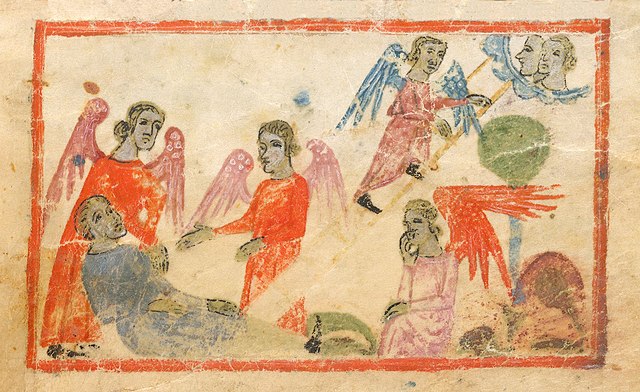
Jacob’s Ladder, “The Sister Haggadah”, 14th century.

Jacob’s Ladder in Freemasonry
Freemasonry deeply resonates with this biblical tale, as Jacob’s Ladder prominently features on the 1st degree tracing board. Richard Carlile, in his Manual of Freemasonry, captures its significance: “The covering of a Freemason’s lodge is a celestial canopy of diverse colours, even as the heavens. The way by which we, as Masons, hope to arrive at it is by the assistance of a ladder, in Scriptures called Jacob’s Ladder. It is composed of many staves, or rounds, which point out as many moral virtues. Three are principal ones—Faith, Hope, and Charity.”
Though Carlile himself was not a Freemason, his early 19th-century work became a resource for English Masonic study, revealing rituals typically kept secret. In the lodge, the ladder symbolises a Mason’s journey toward enlightenment—a stairway from the earthly to the celestial. The lodge itself, roofless in spirit, opens to a star-strewn canopy, mirroring the heavens Jacob beheld. Each rung of the ladder represents a virtue, guiding the seeker upward with purpose and action.
For Freemasons, Jacob’s Ladder is more than a symbol of contemplation—it’s a call to creation. It spans the worlds of action and intimacy, culminating in Atzilut, a mystical realm of closeness with the self and the divine. Just as Jacob awoke to recognise the sacredness of his surroundings, so too does the Mason strive to uncover higher truths, step by step, rung by rung.
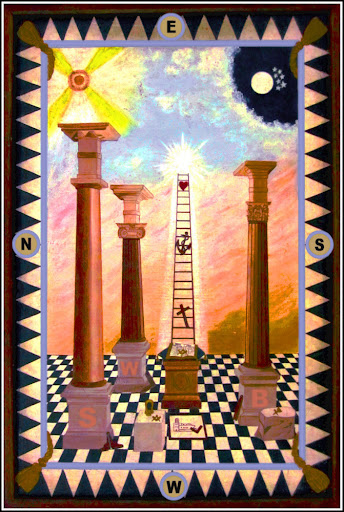
Tracing Board, 1st Degree.
A Timeless Gateway
No story better embodies the Masonic path than Jacob’s dream. It’s a narrative of transformation—of a man on the run who finds his footing on a ladder to the divine. It’s a vision of connection, where prayers rise and promises descend, where the ordinary becomes extraordinary. For both the biblical Jacob and the Freemason, the ladder is a gateway—a bridge to meaning, a journey to light, and a reminder that the sacred is closer than we know.