
Maidenhead Synagogue, Rosh Hashanah 5785, 3 October 2024
What more can be said about the Akedat Yitzhak, the binding of Isaac, a story so central to our tradition, and which I just read to you this Rosh Hashanah morning? This passage is one of the Torah’s most discussed, so much so that Sephardi Jews include it in their daily Shacharit (morning) service.
The Akedah’s enduring power isn’t in a simple retelling of an old man, a divine command, and a near sacrifice on a mountain. If it were just that, it wouldn’t hold our attention so firmly. Our continued fascination stems from the story’s profound depths. Modern readers are often struck by Abraham’s unsettling silence in the face of God’s command. How could a father agree to sacrifice his own child? Yet, Abraham complies without protest, Isaac follows, seemingly aware of his fate, and Sarah, crucially, is absent from the narrative.
Why didn’t Abraham simply refuse? Our ancestors held a different perspective. They didn’t believe God asked too much of Abraham, but rather that Abraham hadn’t done enough. The Talmud recounts the story of a woman whose seven sons were martyred before her eyes (Gittin 57b). Dying for the sake of one’s values was seen as the ultimate sacrifice. When the Romans demanded she kiss an idol, she refused. As her sons were killed, she urged them, “Go and tell your father Abraham, you bound one son on the altar, but I bound seven.”
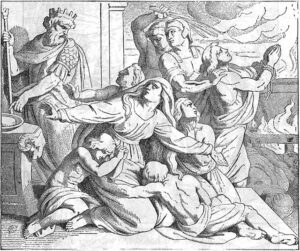
A mother and her seven sons put to death by the King of Syria for not eating pork, 1873.

While we can understand this historical interpretation, as modern readers, we must cultivate our own relationship with tradition. This is essential if we want tradition to remain relevant, to nourish our spiritual lives and to deepen our understanding of Jewish identity.
The Akedah presents a starkly hierarchical dynamic. God is the supreme authority. Abraham, his earthly representative, acts as God’s agent. Isaac, the young men, and the servants are all subject to Abraham’s will. Ishmael, Abraham’s eldest son, is conspicuously absent, and Sarah, his wife, is never mentioned. Even the ram is reduced to a mere object of convenience.
These silences are what I find most compelling, and today, I want us to consider why the Torah might have muted these key voices.
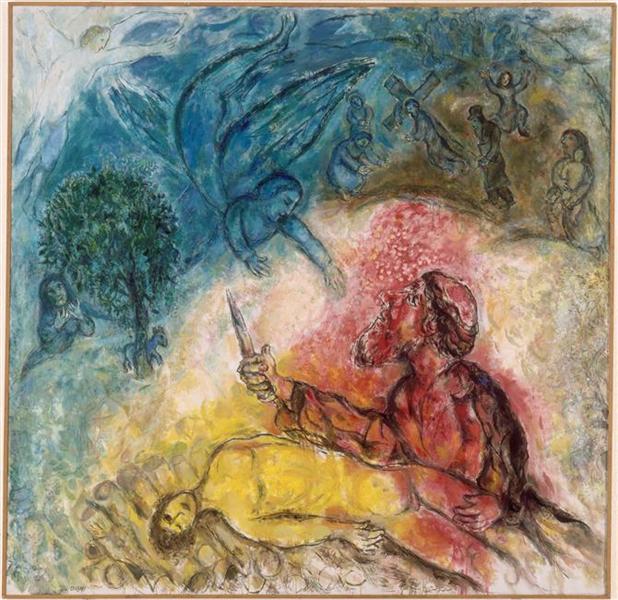
Marc Chagall, The Sacrifice of Isaac, 1966.
The ram, caught in the thicket, becomes a substitute for Isaac. Its horns are transformed into the Shofar, and our tradition teaches us that the Shofar’s call reminds us of the Akedah. But what do these sounds truly convey? Are they the cries of beings exploited for our purposes? Does the Shofar speak for the vulnerable and oppressed? Can one life ever truly replace another? This raises a difficult moral question, one that resonates with the silent victims of war, hatred, and violence.
Abraham’s unquestioning obedience is also troubling. Where is the Abraham who argued passionately with God to save Sodom and Gomorrah? Yet, when commanded to sacrifice his son, he simply prepares for the journey to Mount Moriah. The Torah tells us that Abraham and Isaac travelled for three days to reach the mountain, but it omits any mention of their conversations. We are left to imagine their dialogue, Isaac’s inevitable questions, and Abraham’s internal struggles. Three days offer ample time for second thoughts, yet the Torah remains silent. Abraham, a man of intellect and agency, appears to act without volition.
Some writers have speculated about Abraham’s thoughts during the night before their departure and throughout their three-day journey. Perhaps the Torah is silent because Abraham’s dialogue was with God, a private exchange. Perhaps Abraham questioned God: “What is truly your will? Do you truly want me to kill my son, my heir? You have forbidden child sacrifice, so why this ultimate sacrifice? How will future generations judge me?” Abraham knew God would listen, as He did when Abraham pleaded for Sodom and Gomorrah, even if the answer wasn’t his desired one. But we must acknowledge that divine answers don’t always align with our hopes.
Let us delve deeper: What is the core of this narrative? It is undeniably a test of Abraham’s faith. God asks him to perform an act that contradicts the very ethics God has instilled in humanity through the Torah. Is it possible Abraham has misunderstood God’s command?
The ram, caught in the thicket, is more than a mere substitute. It symbolises the voiceless victims of our world, those who suffer due to forces beyond their control. The Shofar’s blast becomes a powerful call to advocate for those who cannot advocate for themselves.
Abraham’s silence during the journey also prompts questions about faith and obedience. Was his lack of protest a demonstration of unwavering trust, or a failure to challenge a morally reprehensible command? This tension between faith and moral reasoning lies at the heart of the Akedah, forcing us to consider how we reconcile our beliefs with our ethical obligations.
The absence of Sarah’s voice is equally significant. As a mother, her perspective would have provided a crucial dimension to the story. Her silence speaks volumes about the often-marginalised roles of women in biblical narratives and, still today, in our own societies.
Ultimately, the Akedah compels us to confront difficult questions about sacrifice, obedience, and the limits of faith. It challenges us to find our own voices when facing moral dilemmas and to consider the impact of our actions on others, seen and unseen.
When Abraham heard the command, lech-lecha el-Eretz ha-Moriah, ve’a’ahelu sham le’ola – “Go to the land of Moriah and raise him up there” (Gen. 22:2), what did he understand? Most Bible translations render these Hebrew words as “sacrifice him as a burnt offering”, according to the doublea meaning of the Hebrew word olah, consistent with the language of Temple sacrifice elsewhere in the Torah. But did God truly intend for Abraham to immolate his son?
Abraham understood that God desired a different kind of elevation for Isaac: not through fire, but through renown for a sacred purpose – the future of God’s people. Isaac was to be the link between Abraham and the generations of Israel to come, fathering Jacob-Israel, who would sire the twelve tribes. Without Isaac, Abraham’s lineage would end.
At this point, the dynamic of the (text?) test shifted. Abraham resolved to continue until God clarified His intent. As Abraham was about to plunge the knife into Isaac, an angel intervened: “Do not harm the boy.” The narrative transforms from a test of Abraham’s faith to a test of God, a test of whether God would uphold His own word.
Abraham’s silences in the Akedah prompt us to question the true nature of the divine request. In a story where faith and ethics seem to collide, we must ask: Why would God demand the sacrifice of a child?
Ethics becomes the standard, even for God. God cannot ask His people to violate the ethical teachings of the Torah. When we believe our faith demands immoral actions, we have misunderstood God’s message. Zealotry, violence, persecution, and abuse committed in God’s name betray His fundamental message. When a suicide bomber kills himself amidst a crowd, believing he acts according to God’s will, or when someone kills another, claiming divine entitlement to land, God’s word is distorted, and God weeps.
Ethical conduct must always prevail over blind faith. Faith provides the motivation for our actions, while ethics guides our behaviour in the world. This interpretation challenges us to critically examine our understanding of divine commands and their ethical implications. It reminds us that faith should enhance, not diminish, our moral compass. As a Jewish congregation, we are called to grapple with these complex issues, as our ancestors did. The Akedah, therefore, becomes not only a test of faith but also a lesson in moral reasoning and the importance of ethical conduct within our religious practice.
Let us now consider an even more perplexing silence: the absence of Sarah’s voice. The sequence of Genesis chapters 21-23 is notable. In chapter 21, God “remembers” Sarah, and she gives birth to Isaac. In chapter 22, Sarah is completely absent, and she dies at the beginning of chapter 23. What is missing from this account?
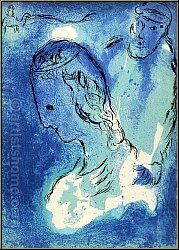
Marc Chagall, Abraham and Sarah.
Some suggest Isaac informed Sarah of the events on Mount Moriah, while others claim Satan brought her the news. In either case, she was so devastated that she died of grief. The thought of such a tragedy befalling her son, without her knowledge, was unbearable. Perhaps Sarah felt betrayed by Abraham, her lifelong partner, for his secrecy.
A Midrash offers insight into Abraham’s thoughts and his reasons for silence: “Abraham reasoned, ‘If I tell Sarah, she will worry excessively – women are prone to anxiety over even small matters, let alone something of this magnitude. But if I take Isaac away without her knowledge, she will kill herself when she cannot find him.”
He said to her, “Let us prepare a feast to celebrate this day.” She asked, “What is the occasion?” He replied, “For old people like us, to have a son is cause for celebration! I will take him away for some education.” She said, “Go in peace.” Without delay, “He rose early in the morning. “Why so early? He thought, “Sarah might change her mind and try to stop me. I will leave before she awakens.” [1]
Another Midrash recounts Isaac’s return. Sarah asked, “Where have you been?” Isaac replied, “Father took me to a mountain. He built an altar, arranged the wood, and raised a knife to slaughter me. But an angel called out to stop him”. At that moment, the Midrash says, Sarah screamed six times, corresponding to the six blasts of the Shofar. [2]
These Midrashic stories illuminate the complex emotions and moral dilemmas faced by our ancestors. As a Jewish congregation, we are called to grapple with these challenging narratives, recognising that they offer profound insights into human nature, faith, and ethics. The silence surrounding Sarah in the biblical text invites us to consider the often-overlooked perspectives within our sacred stories and to reflect on how our actions impact those closest to us.
Sarah’s role as a mother is taken from her. Her trusted partner deceived her, leading to her death from sorrow. Silence diminishes our humanity; silence can be deadly. The ram, Isaac’s substitute, remains nameless. Its sole purpose is to satisfy a divine demand for sacrifice. Yet, its horn, caught in the bushes, becomes the Shofar – the central ritual object of Rosh Hashanah.

Shofar, Hungarian Jewish Museum.

When the Shofar’s primal, heart-rending sounds resonate within us, we hear the voices of those forgotten and silenced. We are urged not to ignore the cries of the living. We are called to reject injustice, suffering, and cruelty. We must rise, speak out, and let the Shofar’s blasts echo throughout the world.
May it be so.